お出かけの前に、オーダーメイドの看板の見積もりをご依頼ください
看板の種類、寸法、数量、素材、照明、電圧、取り付け方法、および納品先国をお知らせください。当社の技術チームがご要望を確認し、推奨仕様と製造リードタイムの見積もりを盛り込んだ工場見積書を作成いたします。.

The glow lies.
LED neon signs and traditional glass neon may look broadly similar in a photograph, yet behind the illuminated line are two radically different systems with different voltages, materials, failure modes, installation demands, shipping risks, and long-term costs.
So why do buyers still compare them as though they were interchangeable?
My blunt answer is that the signage industry has made this discussion unnecessarily vague. LED sellers often describe glass neon as obsolete and dangerous. Glass artisans dismiss flexible LED neon signs as plastic imitation. Both sides are protecting a sale.
The truth is less convenient.
For most restaurants, retail stores, events, hospitality interiors, franchise programs, and exported signage projects, LED neon is the more rational commercial purchase. Traditional glass neon still wins when the objective is authentic tube glow, hand-bent craftsmanship, historic character, or collectible visual art.
Choosing correctly requires more than comparing two supplier quotations.
Traditional neon is a vacuum electric discharge system. A craftsperson heats glass tubing over a flame, bends it into letters or graphics, seals electrodes into the ends, evacuates the tube, and introduces gas at low pressure.
Pure neon produces its familiar red-orange light. Argon is commonly associated with blue light, while phosphor coatings, colored glass, gas mixtures, and sometimes mercury are used to create a broader color range. Reuters documented this hand-built process inside Let There Be Neon, a 3,500-square-foot New York workshop founded in 1972. The Reuters profile of traditional neon craftsmanship also explains why the medium still attracts designers despite the arrival of cheaper LED alternatives. (Reuters)
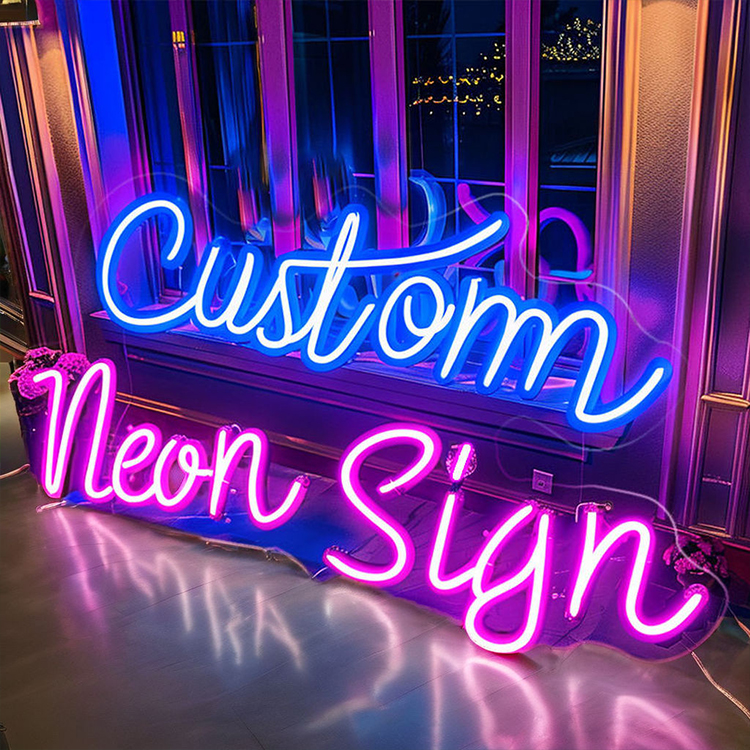
LED neon does not contain luminous gas. It normally uses closely spaced light-emitting diodes inside a flexible silicone, PVC, or similar diffusing profile. The profile softens individual LED points into a continuous-looking line and is commonly mounted onto acrylic, metal, or another structural backing.
その違いは重要です。.
Glass neon generates light through an electrical discharge inside a rigid tube. LED neon generates light from semiconductor diodes behind a diffuser. One is bent with heat by a skilled tube worker. The other is cut, formed, wired, and assembled around a flexible light source.
Buyers considering custom LED neon signs should therefore treat them as fabricated illuminated signs, not as a cheaper grade of glass neon.
Here is the practical comparison I would use before approving a sign specification.
| 意思決定要因 | LEDネオンサイン | Traditional Glass Neon |
|---|---|---|
| Light source | Semiconductor LEDs inside a diffusing profile | Electrified gas inside sealed glass tubes |
| Typical sign-side power | Commonly 12 V or 24 V DC, depending on the system | High-voltage operation through a neon transformer |
| Construction | Flexible silicone, PVC, or similar profile on acrylic or metal backing | Hand-bent glass tubes, electrodes, gas, wiring, and supports |
| Shipping risk | Lower breakage risk, although acrylic can still crack | Higher breakage risk because finished tubes are rigid glass |
| Heat | Usually lower surface heat, but heat management still matters | Tubes and transformers can generate noticeable heat |
| Weight | Generally lighter | Often heavier after frames, transformers, and protective structure are included |
| インストール | Often supplied as a preassembled sign with adapter and mounting hardware | Usually requires more specialized handling and electrical planning |
| 修理方法 | Power supply, wiring, controller, or LED section may be replaced | Broken sections generally require a trained glass-bending repair shop |
| Dimming and control | Dimming, animation, RGB, RGBW, and programmable effects are widely available | Dimming is possible, but complex color-changing effects are less straightforward |
| 視覚的特徴 | Smooth, controlled, contemporary line light | Authentic luminous tube, deeper halo, and handcrafted irregularity |
| Fine lettering | Compact profiles can support relatively tight shapes | Tube diameter and bending limits restrict very small details |
| Outdoor use | Possible with a properly engineered weather-resistant system | Possible with correct housings, electrodes, transformers, and installation |
| Repeat production | Easier to standardize from approved drawings and templates | More variation can occur because tubes are individually hand bent |
| Best commercial fit | Retail, restaurants, events, interiors, rollouts, portable displays | Heritage venues, art installations, vintage branding, permanent statement pieces |
The U.S. National Institute for Occupational Safety and Health describes traditional neon tubes as glass discharge tubes operating under normal conditions at approximately 2,000 to 15,000 volts. The same report notes that neon, argon, internal coatings, and in some cases a small amount of mercury may be used to produce different colors and intensities. Read the NIOSH neon manufacturing evaluation. (疾病控制与预防中心)
That does not mean a correctly manufactured and installed glass neon sign is automatically unsafe.
It means the system should be respected as high-voltage electrical equipment. Transformers, electrode housings, grounding, clearances, wiring, mounting, and local electrical requirements are part of the product—not optional details to be resolved after delivery.
LED neon is commonly low voltage at the illuminated profile, frequently 12 V or 24 V DC. The power supply still connects to building mains, however, so “low voltage” should never be interpreted as “no electrical engineering required.”
Cheap adapters fail. Undersized wiring heats up. Poor waterproofing allows moisture into connections. And a badly ventilated power supply can destroy an otherwise acceptable sign.
Buyers usually ask one question first: what is the LED neon sign cost compared with glass neon?
That is understandable. It is also incomplete.
The initial sign price may exclude artwork conversion, sample development, transformer or power supply, controller, dimmer, mounting template, remote control, hanging kit, wall fasteners, export packaging, installation labor, replacement parts, certification documents, and freight.
Glass neon usually carries more skilled labor because each tube must be formed, processed, filled, tested, and mounted. Its packaging must also protect rigid glass shapes against vibration, impact, and compression.
LED neon can generally be produced faster and shipped with less breakage risk. But poor LED neon is everywhere. Low-density LEDs may create visible bright spots. Thin conductors can cause voltage drop. Weak solder joints fail at bends. Inadequate diffusion produces a dotted rather than continuous line.
Cheap is expensive.
Consider a hypothetical sign operating ten hours per day:
| Example Input | LED Neon Sign | Glass Neon Sign |
|---|---|---|
| Assumed measured input power | 18 W | 60 W |
| Daily operating time | 10 hours | 10 hours |
| Annual operating time | 3,650 hours | 3,650 hours |
| Annual electricity consumption | 65.7 kWh | 219 kWh |
| Cost at USD 0.15 per kWh | USD 9.86 | USD 32.85 |
In this example, LED saves approximately USD 22.99 per year in electricity. That is not enough to justify a procurement decision by itself.
Now multiply the same calculation across 100 locations. Add replacement labor. Add access equipment. Add damaged shipments. Add the cost of locating a qualified glass repairer in every market.
The economics change quickly.
And this is where many supplier comparisons become dishonest: they publish a dramatic energy-saving percentage without showing the sign dimensions, measured input wattage, transformer losses, brightness, operating hours, or electricity tariff.
Demand watts, not adjectives.
ENERGY STAR states that LED lighting products can produce light up to 90% more efficiently than incandescent lamps, while also explaining that LED output gradually depreciates rather than necessarily failing at once. That figure is not a direct LED-neon-versus-glass-neon comparison, but it confirms the broader efficiency advantage of solid-state lighting. See ENERGY STAR’s explanation of LED lighting. (energystar.gov)
For a real project, compare both signs at similar dimensions and perceived brightness. Ask each supplier for measured total input wattage at the plug. Anything else is marketing fog.
“50,000 hours” appears in thousands of LED product listings.
It sounds precise. Usually, it is not.
The U.S. Department of Energy explains that good-quality white LED products may provide approximately 30,000 to 50,000 operating hours or longer. More importantly, LED useful life is often expressed as L70: the time at which output has fallen to 70% of its initial level. It does not necessarily mean every component will remain operational for that entire period. The DOE LED Basics guide makes this distinction clear. (The Department of Energy’s Energy.gov)
An LED neon sign is a system, not an isolated diode.
Its service life can be shortened by:
The power supply may fail before the LEDs. A connection may fail before the power supply. The diffuser may yellow while the sign still illuminates.
That is why I would reject any lifespan claim that is not accompanied by operating voltage, wattage, ambient-temperature assumptions, LED source information, power-supply specification, and warranty terms.

Traditional glass neon has earned its reputation for longevity because well-made tubes can remain operational for many years. Historic signs prove it.
But survival is not the same as zero maintenance.
Electrodes age. Transformers fail. Gas pressure can change. Tubes can crack. Outdoor wiring deteriorates. Water intrusion creates faults. Dirt reduces apparent brightness. A building renovation can damage mounting supports that had previously survived for years.
Glass neon is repairable, which is a major advantage. A skilled shop can often remake a damaged tube section rather than discard the entire sign.
The hard part is finding that shop.
Traditional tube bending is a specialist trade. Reuters reported that LEDs became cheaper to manufacture and traditional neon fell out of favor, even while specialist workshops continued serving artists and brands seeking the real material. That is the commercial tension in one sentence: glass neon can be repaired, but access to qualified repair capacity is increasingly location-dependent. (Reuters)
Glass neon looks like glass neon.
Obvious? Apparently not.
A genuine gas-discharge tube produces a luminous core, reflected halo, and slight variation that flexible LED products imitate but do not perfectly reproduce. Its curves feel physical. The tube has depth. Crossovers, electrode housings, tube supports, and hand-shaped inconsistencies become part of the visual language.
LED neon generally produces a cleaner and more uniform line. It can support sharper graphic planning, smaller profiles, more controlled mounting, easier dimming, and a wider range of programmed effects.
Neither look is universally superior.
Traditional glass neon remains defensible for:
I would not replace a historically significant glass sign with flexible LED merely to reduce a small electricity bill. That can destroy the object’s material authenticity while preserving only its outline.
LED neon is usually the better option for:
Buyers can review existing formats for store and restaurant LED neon signs and compare them with broader restaurant signage planning considerations before deciding whether neon should act as the primary identity sign or as an interior visual feature.
That distinction matters because a beautiful neon wall sign may perform poorly as exterior identification. Visibility distance, daytime contrast, letter height, glazing reflections, surrounding illumination, and viewing angle can matter more than the light-source technology.
Traditional neon is often described online as either completely harmless or dangerously toxic.
Both statements are too broad.
A properly manufactured and installed neon sign can operate safely for years. The more serious material-exposure concerns arise during manufacturing, breakage, repair, and disposal—especially when mercury-containing tubing is involved.
In a NIOSH evaluation of a small neon manufacturing and repair shop, the full-shift mercury-vapor measurement was 0.03 mg/m³. That result was below the OSHA limit cited in the report and below the NIOSH recommended exposure limit, but above the ACGIH threshold referenced by the investigators. Localized real-time measurements reached 0.108 mg/m³ near a contaminated floor area, slightly above the NIOSH ceiling value used in the report. (疾病控制与预防中心)
That was an occupational evaluation of a workshop—not evidence that customers standing near an intact neon sign face the same exposure.
The lesson is narrower: glass-tube fabrication and repair require competent material handling, ventilation, cleanup, and disposal procedures.
The U.S. Environmental Protection Agency lists neon lamps among examples of electric lamps that may fall under universal-waste management rules. The EPA also notes that state programs can differ, so disposal obligations should be checked locally rather than copied from a supplier’s generic compliance statement. Review the EPA universal-waste guidance for lamps. (US EPA)
LED neon avoids gas-filled glass tubing, but it is not impact-free. It includes electronic components, circuit boards, conductors, polymer profiles, acrylic, adhesives, and a power supply. Those parts still create an end-of-life waste stream.
“Mercury-free” does not mean “environment-free.”
Two LED neon signs can look identical online and perform very differently after six months.
Before ordering, specify the following:
Provide vector artwork in AI, EPS, SVG, or editable PDF format. Confirm overall width and height, line thickness, minimum letter height, backing shape, cable exit, mounting holes, and installation orientation.
For small lettering, check whether the proposed profile can reproduce counters, tight curves, and letter spacing without closing gaps.
Request:
Available flexible LED neon light strips can vary in profile size, bend direction, ingress protection, voltage, color control, and material. Those variables should be approved before production rather than selected by the factory without documentation.
Do not accept the word “waterproof” by itself.
Ask for the declared ingress-protection rating of the complete configuration, not just the raw LED strip. The finished sign includes cable exits, soldered joints, connectors, controllers, power supplies, mounting holes, and backing materials. The weakest unsealed component determines real exposure resistance.
Outdoor buyers should also address:
Confirm whether the sign will be:
A sign that cannot be removed without destroying the wall is not a professional installation.
For repeat projects, OEM and ODM signage manufacturing should be based on approved drawings, electrical specifications, mounting templates, component lists, packaging standards, and controlled artwork revisions.
Which is better: LED neon or glass neon?
For most commercial buyers, LED wins.
It is easier to reproduce, easier to ship, easier to control, and usually easier to service. It works well for branded interiors, decorative logos, portable event displays, franchise rollouts, and projects where installation speed matters.
But glass neon still owns the emotional high ground.
Its glow has depth. Its fabrication leaves human evidence. A hand-bent glass sign can feel permanent in a way that a routed acrylic panel with flexible light rarely does.
That does not make it the sensible choice for every business.
I would specify traditional neon when authenticity is central to the brand story and the client accepts specialized installation, packaging, and future repairs. I would specify LED neon when the buyer needs predictable replication, lower logistical risk, programmable control, or deployment across multiple sites.
The best neon signs for business are not the signs with the loudest supplier claims. They are the signs whose construction matches the operating environment, brand position, service network, and budget.
LED neon is the better choice for most commercial interiors, multi-site rollouts, events, and export orders because it is lighter, less fragile, easier to install, commonly runs on low-voltage DC after the power supply, and usually costs less to operate and service than traditional glass neon.
Glass neon remains the stronger choice for historically accurate restorations, commissioned artwork, vintage branding, and projects where genuine hand-bent tubing is an essential part of the visual concept.
An LED neon sign’s useful life is the period until its light output falls to a defined threshold, commonly L70, rather than the day it suddenly stops working; the U.S. Department of Energy says good-quality white LED products are generally expected to provide 30,000 to 50,000 operating hours or longer.
Actual sign life also depends on heat, power-supply quality, LED loading, moisture protection, wiring, ambient temperature, operating schedule, and the quality of the flexible profile.
LED neon signs generally use less electricity than comparable traditional neon installations because solid-state LEDs can produce visible light at lower operating wattage, but the saving should be verified by comparing measured plug-level power for signs of similar size, brightness, color, and daily operating hours.
A supplier who provides only a percentage without wattage, dimensions, and testing conditions has not provided usable energy data.
Traditional glass neon is not inherently dangerous when it is properly fabricated, installed, grounded, protected, and maintained, but it combines fragile glass with high-voltage electrical equipment and may involve mercury-containing tubes, making competent handling especially important during production, repair, accidental breakage, removal, and disposal.
Local electrical codes and waste rules should be checked before installation or decommissioning.
LED neon is usually cheaper than traditional glass neon for standard commercial lettering and graphics because its production is less dependent on specialist glass bending, its packaging can require less protection, and installation, replication, color control, and replacement-part logistics are generally more straightforward.
Complex artwork, RGB control, thick acrylic, stainless-steel structures, weatherproof construction, and certification requirements can still raise the LED quotation substantially.
Outdoor LED neon signs are flexible illuminated systems engineered with weather-resistant profiles, sealed joints, protected cable exits, suitable backings, and properly enclosed power components, but the outdoor rating must apply to the complete assembled sign rather than only to the raw LED strip supplied inside it.
Request the ingress-protection rating, temperature range, UV-resistance information, mounting details, and power-supply enclosure specification before approving production.
Do not begin with “How much is a neon sign?”
Begin with dimensions, artwork, viewing distance, installation location, operating hours, voltage, mounting method, target colors, indoor or outdoor exposure, quantity, and delivery country.
Then compare the complete system.
For a custom project, request a factory signage quotation with your vector artwork and technical requirements. Ask for a documented proposal covering the LED profile, backing material, electrical configuration, mounting hardware, packaging, production drawings, and replacement components before approving the order.
コメント