Получите индивидуальный расчет стоимости вывесок, прежде чем уйти
Сообщите нам тип вывески, размеры, количество, материалы, тип подсветки, напряжение, способ крепления и страну доставки. Наша команда инженеров рассмотрит ваши требования и подготовит коммерческое предложение с рекомендуемыми техническими характеристиками и ориентировочными сроками изготовления.
Прежде чем уйти, получите расценки от завода-изготовителя
Предоставьте нам свои чертежи, размеры, информацию о материалах, количествах, требованиях к освещению и месте доставки. Наша команда инженеров-рекламщиков рассмотрит ваш проект и подготовит индивидуальное предложение по изготовлению светодиодных букв, световых коробок, пилонных вывесок, вывесок для АЗС или других нестандартных вывесочных систем.
Gas Station Signage: A Complete Buyer’s Guide for New Builds and Rebranding
Signs sell fuel.
That sounds simplistic, but a driver approaching at speed has only seconds to recognize the brand, read the fuel price, identify the entrance, judge whether the site feels open and safe, and decide whether turning in is worth the effort.
Why, then, do so many buyers treat gas station signage as decoration?
The hard truth is that a beautiful sign can still be commercially useless. It may be too short for the road geometry, too dim against afternoon sun, too complicated to maintain, illegal under the local sign code, or impossible to install without modifying the foundation.
I have a blunt view on this: gas station signage should be purchased as infrastructure, not artwork.
That distinction matters in a crowded industry. The 2026 NACS/NIQ Convenience Industry Store Count identified 151,975 U.S. convenience stores, including 122,620 stores selling motor fuel. Those fuel-selling locations increased by 768 sites, or 0.6%, from the previous year, reaching their highest count in eight years.
A station is not competing only with the fuel retailer across the street. It is competing with more than 100,000 fuel-selling convenience locations, recognizable petroleum brands, supermarket fuel centers, truck stops, warehouse clubs, and increasingly complex forecourts offering gasoline, diesel, E85, compressed natural gas, and EV charging.
Your signage has to work harder.
Define the Commercial Job Before Designing the Signs
The first procurement mistake usually happens before any material is selected. Someone opens a brand manual, chooses a pylon shape, and asks three suppliers for a quote.
That is backwards.
Start by defining what the signage must accomplish:
Identify the station from each major traffic approach.
Communicate fuel prices before the driver reaches the decision point.
Show entrances, exits, diesel lanes, truck access, car wash access, and parking.
Carry the petroleum brand consistently across the pylon, canopy, pumps, store, and directional signs.
Remain readable during daylight, darkness, rain, glare, and partial obstruction.
Permit safe maintenance without shutting down half the forecourt.
Support later changes to fuel grades, prices, tenant panels, or service offers.
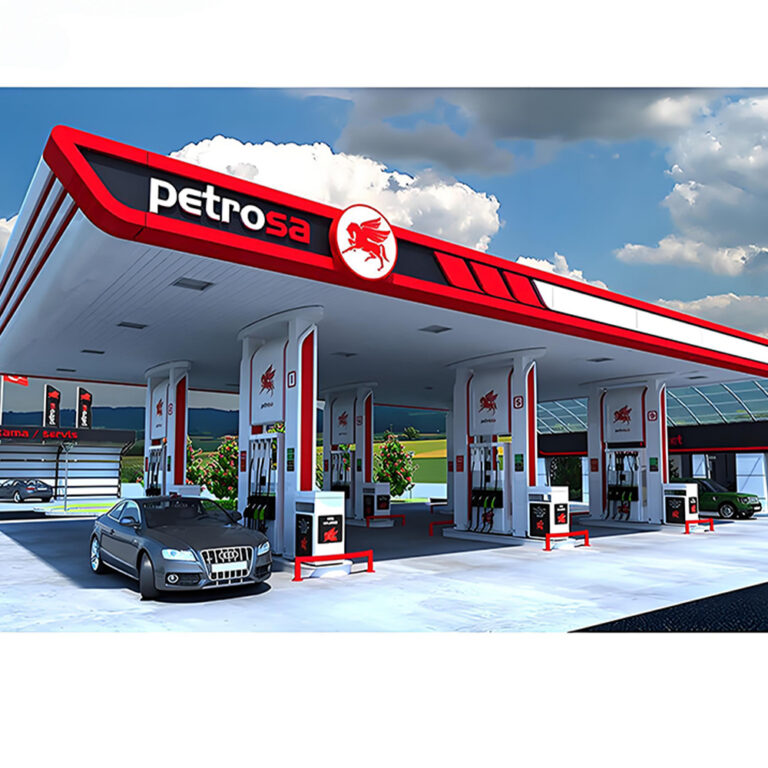
A buyer planning a complete forecourt can review the available gas station signage systems as a starting point, but the final package must be built around the site rather than copied from a product photograph.
New Builds Have Freedom—and More Ways to Get It Wrong
A new build allows the owner, architect, civil engineer, petroleum consultant, electrical contractor, and signage manufacturer to coordinate foundations, conduit, sign setbacks, canopy elevations, branding zones, and installation access before the concrete is poured.
That is the opportunity.
But new projects also produce expensive coordination failures. A pylon foundation may be placed before the sign’s wind-load calculations are approved. Electrical conduit may terminate in the wrong cabinet section. Canopy cladding dimensions may be taken from drawings rather than verified steelwork. Fuel-price displays may arrive with a control system that cannot communicate through the site’s actual network.
Small errors multiply.
For a new build, signage shop drawings should be coordinated with the architectural, civil, structural, electrical, and petroleum-equipment packages. “Approved logo artwork” is not enough.
Rebranding Is a Forensic Exercise
Rebranding looks easier because the station already has signs.
Often, it is harder.
Existing pylons may contain undocumented steelwork, corroded fasteners, obsolete fluorescent lighting, nonstandard cabinets, locally fabricated foundations, damaged waterproofing, or old price modules that cannot accept new controllers. The visible sign face tells you very little about the structure behind it.
So measure everything.
A serious rebranding survey should record overall dimensions, cabinet depths, pole sizes, foundation information where available, access panels, internal framing, electrical voltage, circuit capacity, existing LED or lamp types, face-retention details, attachment points, corrosion, drainage, cable routes, and photographs from every traffic approach.
Do not quote from one front-facing image. That is not estimating; it is gambling.
Build a Complete Gas Station Signage System
Gas station branding works when each sign has a specific job. Problems begin when one structure is expected to identify the brand, display six prices, advertise a car wash, direct trucks, promote food, show an EV logo, and carry a changeable message—all within one cluttered rectangle.
Drivers do not study signs.
They scan them.
Gas Station Pylon Signs: Win the Approach
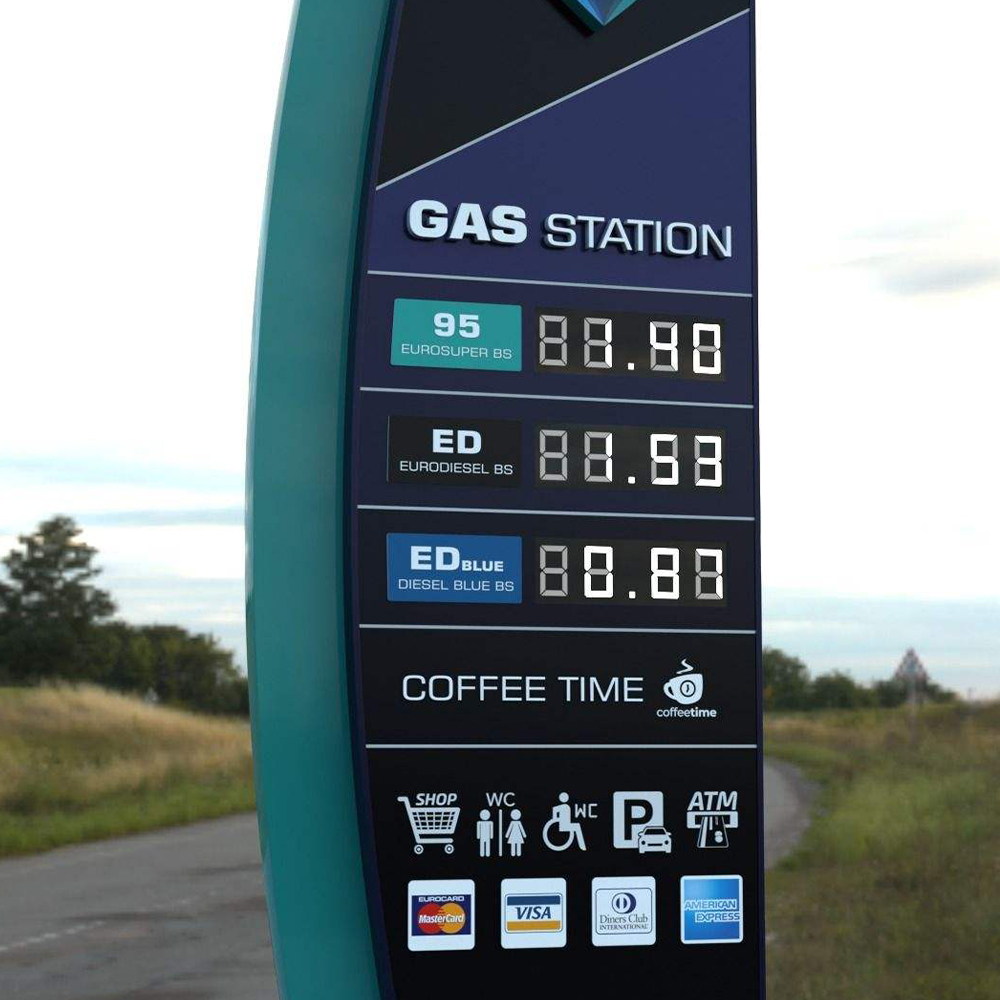
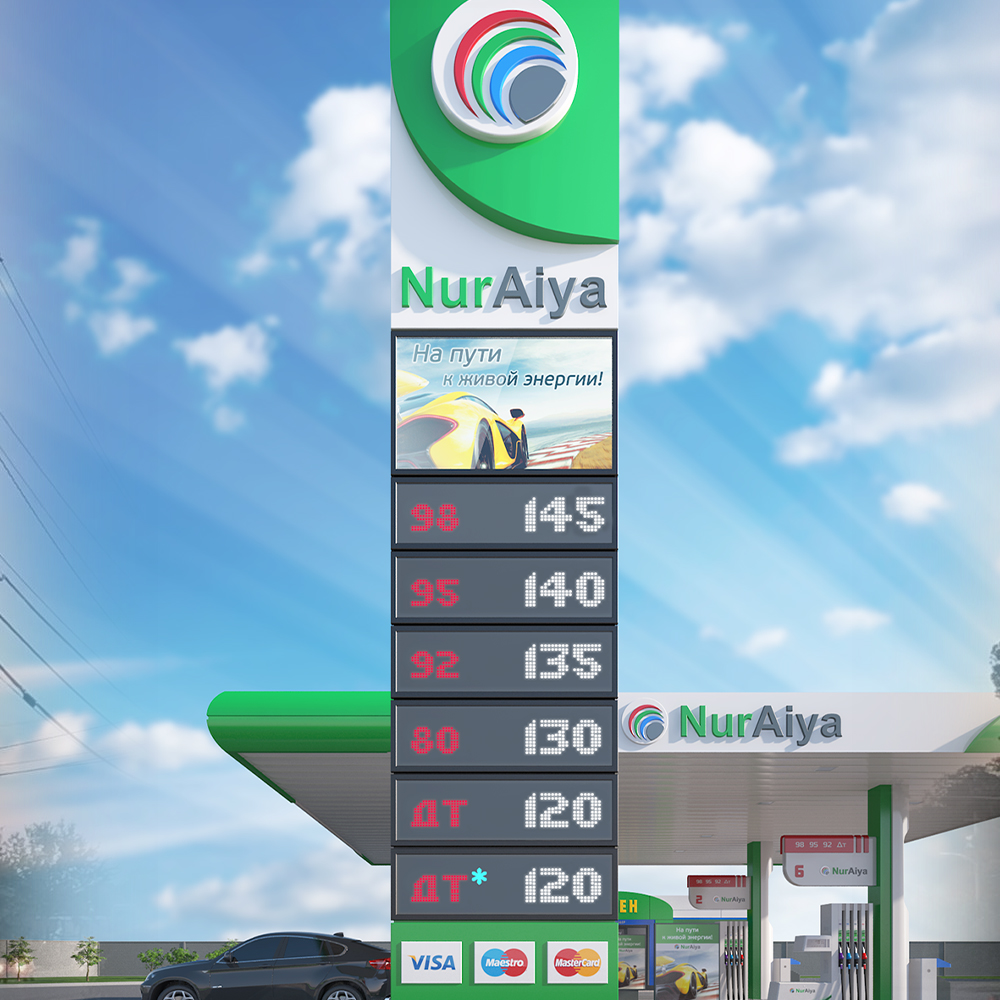
The pylon is usually the first major brand contact. It may combine a petroleum logo, fuel-grade labels, digital prices, convenience-store identity, car-wash information, directional arrows, and secondary tenant panels.
Its job is distance.
Этот gas station pylon sign range includes configurations such as 6 m and 8 m structures, illuminated identity sections, segmented LED price displays, and single- or double-sided cabinets. These are useful manufacturing references, not automatic recommendations for every site. The correct height is governed by sightlines, setbacks, road elevation, traffic approach, obstructions, wind exposure, and local code.
A taller pylon is not always better. Beyond a certain point, added height may increase steel weight, foundation demand, crane requirements, permitting difficulty, freight volume, and installation cost without materially improving readability.
The buyer should ask one uncomfortable question: from where must the price become readable?
Stand there. Photograph it. Record the approximate distance. Repeat the exercise from every relevant approach lane.
Fuel Price Signs: Accuracy Before Animation
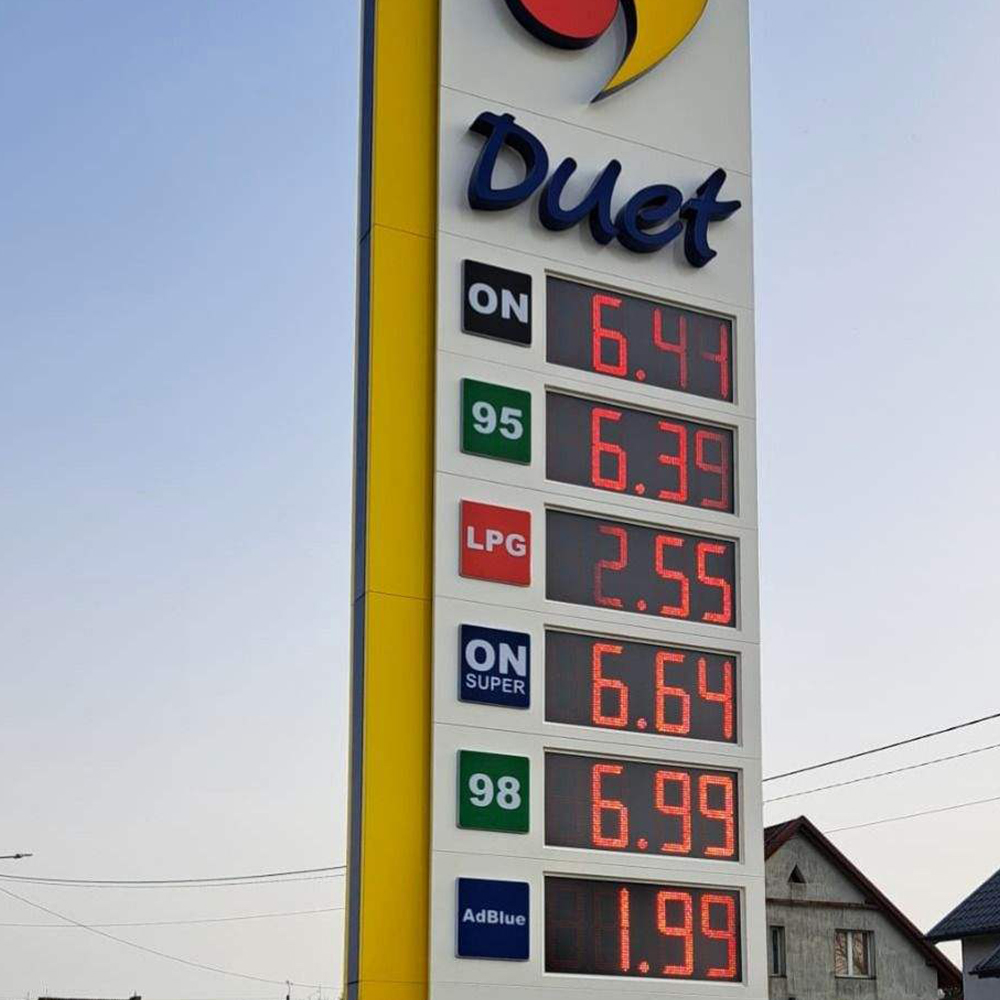
Fuel price signs are working retail equipment. They are not merely illuminated numbers.
The system may include:
Static interchangeable number panels
LED 7-segment digits
Modular digital price sections
Single-sided or double-sided displays
Pump toppers
Local handheld controllers
Radio-frequency controls
Wired communication
Networked remote-management systems
Current custom gas price sign configurations include 12-inch modular panels, segmented LED displays, pump toppers, remote controls, and configurable brightness, color, communication, and cabinet dimensions.
But do not buy a controller before answering basic questions. How many grades are displayed? Will cash and credit prices differ? Is diesel included? Is the fractional ninth shown? Will prices be updated from the store, a regional office, or a pricing platform? What happens when communication fails?
Price integrity carries legal exposure. NIST’s state-by-state retail pricing law directory shows that motor-fuel price posting and enforcement requirements vary across U.S. jurisdictions. State and local weights-and-measures authorities commonly enforce pricing rules, so the roadside display, pump price, point-of-sale system, and advertised discount conditions must remain synchronized.
My opinion is simple: never allow a supplier to treat the digit display, controller, and station operating procedure as three unrelated decisions.
Canopy Fascia Signs: Make the Site Recognizable
The canopy becomes the station’s dominant visual object once the customer reaches the site. Its fascia may include illuminated color bands, dimensional logos, corner treatments, accent lighting, and brand-specific cladding.
Good canopy branding creates continuity.
Bad canopy branding creates visible seams, uneven illumination, mismatched colors, dark corners, warped panels, exposed fasteners, or logos that appear to float in the wrong position.
The available gas station canopy fascia systems include modular panels, color bands, corner sections, and integrated illuminated logos for new stations and brand-conversion projects.
For procurement, divide the canopy into measurable elevations. Mark the beginning and end of every panel, corner, logo, joint, access point, downpipe, camera, luminaire, and obstruction.
And verify the built structure.
Architectural drawings show design intent. They do not always show what the steel contractor actually installed.
Building Signs, Directional Signs, and Forecourt Identification
The store façade should confirm the identity already introduced by the pylon and canopy. Depending on the brand, this may use channel letters, illuminated logo boxes, cabinet signs, window graphics, or wall-mounted panels.
Directional signs handle different information:
Entrance and exit
One way
Diesel
Truck entrance
Car wash
Air and water
Parking
Delivery access
EV charging
Accessible entrance
Restrooms
Emergency shutoff identification
These signs should use short messages, consistent arrows, high contrast, and predictable placement. A directional sign that becomes readable only after the driver passes the turn has failed, regardless of its manufacturing quality.
Compare the Sign Types Before You Buy
Sign component
Основная должность
Common configuration
Information the buyer must specify
Frequent procurement failure
Рекламный щит на опоре
Long-range station identification
Freestanding illuminated cabinet with brand and prices
Overall height, viewing sides, foundation interface, wind criteria, price rows, service panels
Selecting height from a catalog without a sightline survey
Fuel price display
Communicate current prices
Static digits or remotely controlled LED modules
Digit height, number of grades, color, brightness control, communication method, price format
Controller and point-of-sale requirements left unresolved
Canopy fascia
Establish forecourt identity
Modular illuminated bands, panels, corners, and logos
Using generic templates for different dispenser models
The table exposes a wider issue: most poor quotations are missing project information, not manufacturing capability.
Suppliers cannot accurately price what buyers have not defined.
Specifications That Separate Real Quotes From Placeholder Quotes
The cheapest sign quote is often the most expensive document on the job.
Why? Because vague quotes transfer risk back to the buyer.
A serious request for quotation should include the following categories.
Structure and Materials
State the proposed cabinet material, internal frame material, face material, panel thicknesses, reinforcement method, access-door construction, drainage, fasteners, protective coating, and expected exposure conditions.
“Aluminum sign” is not a specification.
Is the aluminum a thin decorative skin over steel? Is the complete cabinet aluminum? Are internal brackets galvanized? Are fasteners stainless steel? Are dissimilar metals isolated? Can water drain from the lowest cabinet section?
These details decide how the sign looks after several winters, not just on installation day.
Illumination and Electrical Components
The quotation should identify the LED module model, color temperature or color, rated voltage, power supply model, driver loading, circuit arrangement, cable type, grounding provisions, surge protection, dimming or photocell method, ventilation, and component access.
Ask for replaceability.
A proprietary LED strip bonded inside a sealed cabinet may look clean in a sample. Five years later, it can turn a minor lighting failure into a complete face-removal exercise.
For digital price signs, request declared daytime brightness, automatic or scheduled dimming, numeral color, viewing angle, operating-temperature range, communication method, and manual override procedure. High brightness without nighttime control can create glare; low brightness disappears in direct sun.
Color Control
Brand red is not “red.”
Specify Pantone, RAL, CMYK, printed references, translucent-film references, paint codes, acrylic colors, and acceptable tolerances where applicable. More importantly, decide which reference governs when painted metal, translucent acrylic, printed vinyl, and illuminated graphics cannot produce identical visual results.
Approve both daytime and nighttime samples.
A color match under office lighting proves almost nothing about an internally illuminated canopy at 10 p.m.
Installation Interface
The manufacturer needs foundation drawings, base-plate geometry, anchor-bolt patterns, embedded conduits, lifting points, section weights, shipping splits, mounting brackets, access clearances, and wiring responsibilities.
Who supplies the anchor cage?
Who calculates the foundation?
Who provides stamped structural drawings where required?
Who connects the final circuit?
Who commissions the remote price controller?
Write the answers into the contract. Memory is not project management.
Compliance Is Not a Final Checkbox
Buyers sometimes order the sign first and ask the permit consultant to “make it work.”
That is a costly habit.
Local codes may regulate sign height, area, setbacks, illuminated surface, brightness, digital-message changes, landscaping around foundations, proximity to rights-of-way, and whether an existing nonconforming sign can be modified without losing its grandfathered status.
The legal framework is not theoretical. In the 2022 case Город Остин против компании «Reagan National Advertising of Austin», the U.S. Supreme Court held that Austin’s distinction between on-premises and off-premises signs was facially content neutral under the First Amendment. For buyers, the practical message is that location-based sign classifications remain significant and can affect whether digitization or alteration is permitted.
Do Not Confuse Highway Signs With Your On-Site Sign
The Federal Highway Administration’s 11th Edition of the Manual on Uniform Traffic Control Devices covers Specific Service signs that provide road users with business identification and directions to qualifying gas, food, lodging, camping, attraction, pharmacy, and alternative-fuel services. These public-road signs are separate from the station’s privately installed pylon.
A logo panel on an Interstate service sign does not approve the pylon at the property entrance.
Different owner. Different permit. Different technical standard.
Accessibility Signage Has Measurable Requirements
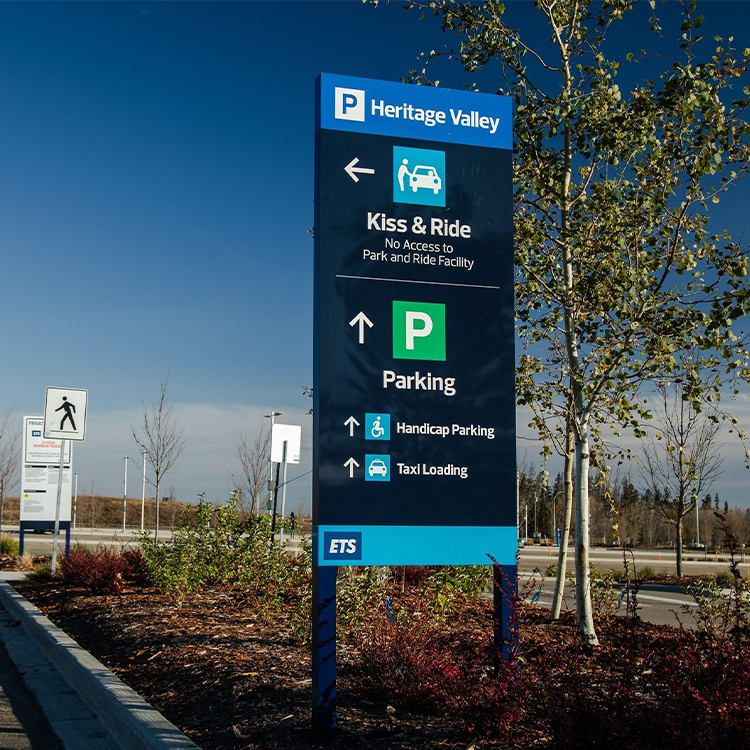
Under the 2010 ADA Standards, accessible parking identification signs generally must include the International Symbol of Accessibility. Signs identifying van-accessible spaces must also include the “van accessible” designation and be mounted at least 60 inches above the ground, measured to the bottom of the sign. Van routes and spaces are also subject to a 98-inch minimum vertical-clearance requirement in applicable configurations.
Этот ADA guidance for accessible parking should be reviewed alongside state and local accessibility rules. A generic blue parking sign ordered from a catalog does not prove the parking layout is compliant.
New Build vs. Rebranding: The Procurement Differences
New-Build Priorities
For new construction, lock the signage package before foundations, canopy cladding, and final electrical work.
The recommended sequence is:
Complete traffic-approach and site sightline review.
Confirm the sign code and permit path.
Freeze brand standards and message hierarchy.
Coordinate pylon foundations and conduit routes.
Verify canopy and building attachment details.
Approve engineering drawings and finish samples.
Fabricate and preassemble major sign sections.
Test illumination, controllers, and wiring before shipment.
Install after required civil and electrical work is ready.
Commission the system and record final settings.
Do not release fabrication because the opening date is approaching. Schedule pressure does not improve incomplete drawings.
Rebranding Priorities
For rebranding, first classify every existing asset:
Retain unchanged
Reface
Repaint
Relight
Modify structurally
Replace completely
Remove without replacement
This prevents the wasteful assumption that every old sign must be demolished.
A sound conversion may retain an existing pylon structure while replacing faces, branding panels, LED modules, price displays, controls, wiring, and exterior finishes. But that decision should follow inspection, not optimism.
The rebrand schedule must also account for temporary signs, price-display continuity, phased canopy work, customer access, fuel-delivery routes, electrical shutdowns, and the period when old and new branding might appear together.
Nothing makes a brand conversion look less controlled than a new canopy paired with a faded pylon and obsolete pump graphics.
How to Compare Gas Station Signage Suppliers
A polished rendering is easy.
Repeatable manufacturing is harder.
When comparing suppliers, request the same deliverables from each bidder:
Рабочие чертежи с размерами
Спецификация
Structural configuration
Electrical schematic
LED and power-supply models
Price-controller details
Толщина материалов
Finish and color references
Component certifications applicable to the quoted configuration
Sample or prototype plan
Контрольный список для проверки
Способ упаковки
Section dimensions and weights
Spare-parts list
Installation documentation
Условия гарантии
Replacement-component procedure
Этот OEM and ODM signage engineering process explains why drawings, brand files, samples, illumination, voltage, mounting, and approved manufacturing specifications should be settled before materials are released.
And compare total cost, not factory price alone. The site’s signage procurement and lifecycle-cost resources provide a useful framework for evaluating materials, maintenance, logistics, supplier risk, repeat orders, and long-term value.
A low quote can become expensive through oversized freight crates, missing structural parts, local electrical rework, poor access panels, custom replacement modules, repeat crane hire, or delayed opening.
Ask each supplier what is excluded.
Then read that answer twice.
The Buyer’s Pre-Quotation Checklist
Before requesting a final quotation, prepare:
Site address and destination country
New build or rebranding status
Site plan and elevations
Traffic-approach photographs
Required sign types and quantities
Габаритные размеры
Viewing sides
Brand manual and vector artwork
Pantone, RAL, paint, vinyl, and acrylic references
Fuel grades and price rows
Static or LED pricing
Digit height and color
Controller and communication requirements
Input voltage and electrical standards
Structural design criteria supplied by the project engineer
Foundation and anchor interface
Canopy as-built dimensions
Building wall construction
Mounting methods
Illumination method
Brightness-control requirements
Required samples or prototypes
Permit-document requirements
Inspection requirements
Packing constraints
Ответственность за установку
Delivery deadline
Потребность в запасных частях
No supplier can remove uncertainty from missing information. They can only hide it inside the price.
Часто задаваемые вопросы
What signs does a new gas station need?
A complete new-build gas station signage package is a coordinated system of roadside identification, fuel-price communication, canopy branding, building identification, pump graphics, directional signs, safety notices, accessible-parking signs, and service messaging designed around one approved site plan, brand standard, electrical design, and installation sequence.
The exact list depends on the property, petroleum brand, fuel grades, store services, road approaches, local sign code, parking layout, and whether the site includes diesel, car wash, food, truck access, or EV charging.
How do I choose gas station signage?
Choosing gas station signage means matching sign type, size, brightness, materials, control system, mounting, and structural design to actual approach speed, viewing distance, site geometry, local code, brand rules, weather exposure, maintenance access, and future price or service changes rather than selecting from a catalog by appearance alone.
Begin with a site survey and permit review. Then define what each sign must communicate, where it must become readable, who will maintain it, and which parts may need to change during the station’s operating life.
Are LED fuel price signs better than static price signs?
An LED fuel price sign is an electronically controlled numeric display that lets operators change fuel prices remotely or locally without replacing physical digits, making it best for stations with frequent price changes, multiple grades, difficult sign access, or multi-site operating standards that require fast and consistent updates.
Static signs may still suit low-change environments, small sites, or projects with limited electrical infrastructure. The decision should compare controller integration, daylight readability, dimming, maintenance, replacement parts, operating environment, and total ownership cost.
What is the difference between a pylon sign and canopy signage?
A gas station pylon sign is a freestanding roadside structure used for long-distance identification and fuel pricing, while canopy fascia signage is the illuminated or non-illuminated branding system attached around the fuel canopy to identify the station once drivers enter or pass the forecourt.
The pylon competes for attention from the road. The canopy organizes the visual identity within the site. They should share colors, logo proportions, illumination quality, and messaging hierarchy without duplicating every piece of information.
What approvals are required for gas station signage?
Gas station signage approval is the combined process of securing local zoning and sign permits, structural and electrical review, landlord or petroleum-brand approval, utility coordination, and any state pricing or accessibility compliance required before fabrication, excavation, wiring, installation, or energizing of the sign system.
Requirements vary by jurisdiction. The project team should verify sign area, height, setbacks, illumination, digital displays, foundations, wind criteria, electrical listing, accessible parking, roadside restrictions, and motor-fuel price-posting rules with the authorities responsible for the actual site.
How should a multi-site gas station rebranding rollout be planned?
A gas station rebranding rollout is a controlled conversion program that replaces or modifies pylon faces, price modules, canopy fascia, logos, directional signs, pump graphics, and building identification across one or many operating sites while minimizing closures, mismatched branding, permit delays, and discarded reusable structures.
Survey every site separately, but use one controlled specification system. Create approved component families, measurement forms, color references, drawing templates, installation manuals, packaging labels, spare-parts lists, and revision records so local differences do not destroy brand consistency.
Your Next Step: Build the Specification Before Requesting Prices
Do not begin with, “How much is a gas station sign?”
Begin with the site.
Prepare the traffic views, sign schedule, approximate dimensions, fuel grades, pricing format, brand files, electrical requirements, mounting conditions, destination, and project timeline. Then ask the manufacturer to identify missing information and convert the package into coordinated production drawings.
For a new station, request one complete forecourt signage proposal. For rebranding, request a retain-reface-replace assessment before authorizing demolition.
Send your project drawings and site information to obtain an engineered quotation for the pylon, fuel price displays, canopy fascia, store branding, and directional signage as one coordinated system—not five unrelated purchases.
Компания «Custom Signage Factory» занимается производством коммерческих вывесок для рекламных агентств, подрядчиков, дистрибьюторов и сетевых брендов. Располагаясь производственными площадями площадью 20 000 м², штатом из более чем 80 производственных работников, парком оборудования из более чем 50 единиц и годовой производственной мощностью 100 000 единиц, мы производим светодиодные буквы, световые короба, пилонные вывески, вывески для АЗС, неоновые вывески и индивидуальные вывесочные системы по заказу (OEM).