Tell us your sign type, dimensions, quantity, materials, illumination, voltage, mounting method, and delivery country. Our engineering team will review your requirements and prepare a factory quotation with recommended specifications and estimated production lead time.
Before You Leave, Get a Factory Quote
Share your drawings, dimensions, materials, quantities, illumination requirements, and delivery destination. Our signage engineering team will review your project and provide a tailored manufacturing proposal for LED letters, light boxes, pylon signs, gas station signage, or other custom sign systems.
Front-Lit and Backlit Channel Letters: When Dual Illumination Makes Sense
Dual-lit channel letters make sense when a business needs the long-distance readability of a bright face and the architectural depth of a rear halo from the same sign. They are best suited to flagship storefronts, hotels, restaurants, dealerships, and competitive retail sites where the mounting wall can reflect light cleanly.
More light wins.
But when two LED systems are treated as one visual package without separate optical control, the face becomes harsh, the halo becomes muddy, power demand rises, service access worsens, and the sign costs more while communicating less.
So why do buyers keep specifying both light paths by default?
The answer is simple: dual illumination photographs well. It looks expensive in a rendering. Sales presentations love it.
Real buildings are less forgiving.
Dual-Lit Channel Letters Are Not Automatically Better
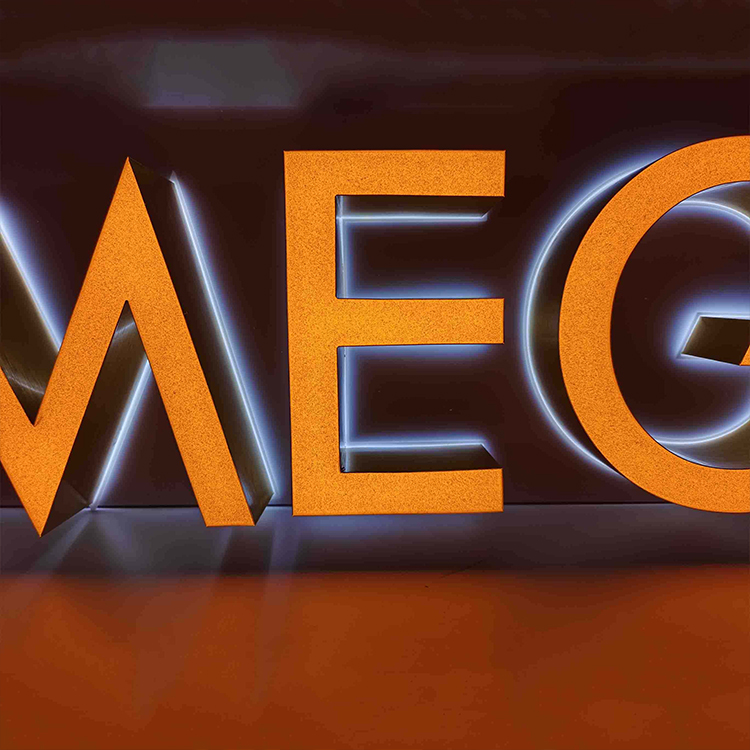
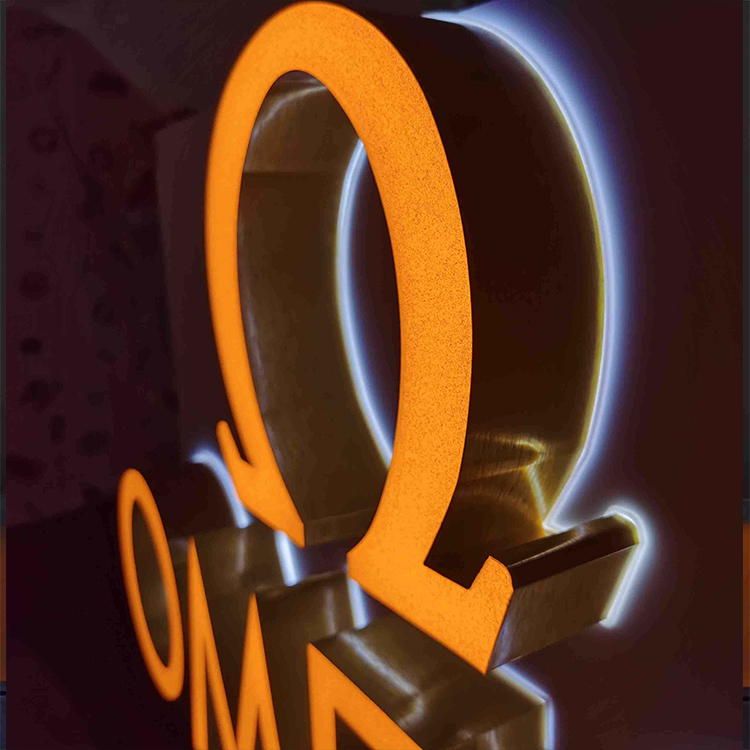
Dual-lit channel letters—also called front and back lit channel letters, face and halo lit letters, or combination channel letters—send light in two directions:
Forward through a translucent acrylic face.
Backward onto the building surface to create a halo.
The front light carries the message. The halo adds visual depth.
That distinction matters. The halo should support the letter shape, not compete with it. When both lighting systems are driven at maximum output, the result often looks swollen rather than refined. Letter spacing disappears, counters inside characters such as “A,” “B,” “O,” and “R” become visually crowded, and brand colors lose control.
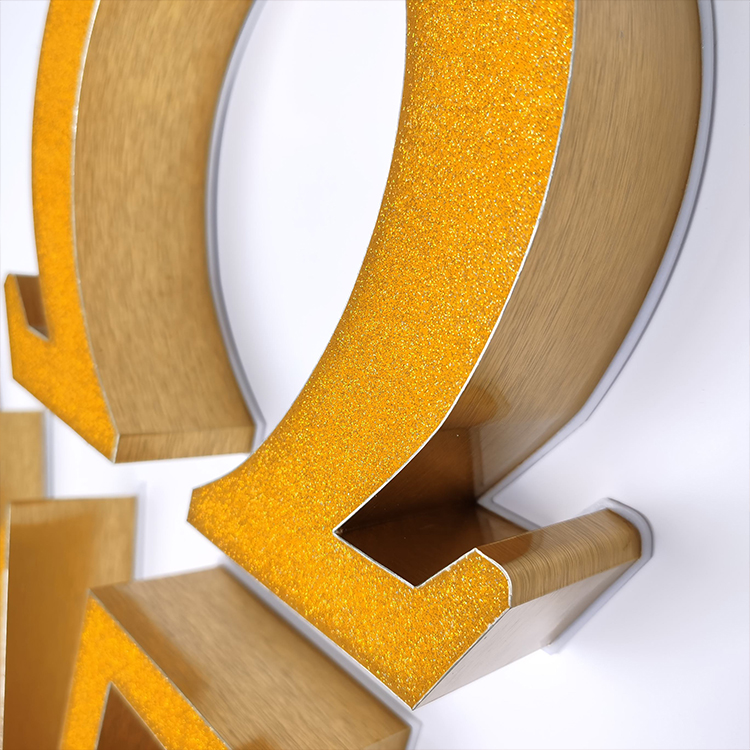
A properly engineered dual-lit acrylic channel letter can use an illuminated face, waterproof LED modules, and a 20 mm clear acrylic rear panel to create the two effects. However, the final result still depends on wall reflectance, letter depth, LED spacing, stand-off distance, color temperature, power loading, and installation quality.
My hard rule is this: do not buy dual illumination unless you can explain what each light direction is supposed to accomplish.
Flagship stores, entertainment venues, premium restaurants, mixed-use projects
High
Highest
Face and halo competing with each other
RGB dual-lit letters
Independently controlled colored face and halo
Bars, clubs, events, branded experience spaces
High
Very high
Color inconsistency, controller failure, visual clutter
For projects where direct readability is the main requirement, LED frontlit letters are usually the more rational choice. They send most of the available light toward the viewer and require fewer lighting components.
For hotels, offices, luxury stores, and architectural walls where atmosphere matters more than maximum distance visibility, LED backlit letters can produce a cleaner result. The opaque metal face remains visually controlled during the day while the rear light creates the nighttime identity.
Dual illumination sits between those two systems. It should be chosen because the project genuinely needs both functions—not because it appears higher on a supplier’s price list.
When Dual Illumination Earns Its Cost
The Site Operates in Mixed Lighting Conditions
A storefront may face direct sun at 3:00 p.m., heavy street lighting at 7:00 p.m., and a darker pedestrian environment after 11:00 p.m.
A face-only sign can perform well in daylight and busy commercial lighting. A halo-only sign can look refined after dark but lose frontal readability when surrounding light levels rise.
Dual-lit channel letters can bridge those conditions. The illuminated face preserves the wordmark, while the rear halo separates the letters from the façade.
This is especially useful for:
Flagship retail stores
Hotels and serviced apartments
Restaurants with late operating hours
Automotive dealerships
Cinemas and entertainment venues
Mixed-use developments
High-competition shopping streets
Branded entrance walls visible from both vehicles and pedestrians
The word “flagship” matters. A standard branch location does not always need the same visual investment as a high-profile store in Times Square, Orchard Road, Oxford Street, or a major airport retail zone.
The Brand Needs Color and Architectural Depth
A halo-lit sign usually has an opaque face. That can limit the ability to display a bright brand color directly toward the viewer.
Dual illumination removes that compromise.
A red, blue, green, or custom vinyl-faced letter can glow forward while a 3000 K warm-white, 4000 K neutral-white, or 6500 K cool-white system produces the rear halo. Separate circuits may also allow the face and halo to be dimmed or controlled independently.
That combination is useful when:
Corporate identity requires a specific illuminated face color.
The architect wants a floating letter effect.
The property owner requires a premium nighttime appearance.
The sign must remain readable from a moving vehicle.
The same design will be repeated across several high-value locations.
The frontlit and backlit letter collection includes acrylic and stainless-steel configurations intended for commercial walls, retail façades, restaurants, offices, and outdoor branding.
The Sign Is a Building Feature, Not Just an Identifier
There is a commercial difference between a sign that tells customers where a business is and a sign that forms part of the building’s identity.
The University of Cincinnati’s signage research examined a national survey of more than 160 businesses and found that companies generally invested in signage to stand out and help customers find their locations. The researchers’ broader conclusion was not that “more signage always wins,” but that design and placement influence the return generated by a sign investment. University of Cincinnati signage research supports the business value of treating signs as communication assets rather than decorative hardware.
That is where dual illumination can make sense. It gives the sign two visual layers:
A clear information layer through the illuminated face.
An architectural layer through the reflected halo.
But both layers must remain legible.
When Dual-Lit Channel Letters Are a Bad Purchase
Here is the unpopular part: many dual-lit signs should have been front-lit signs.
The Sign Is Read Mainly From Long Distance
A tenant sign viewed from 60, 100, or 200 feet away does not automatically benefit from a delicate halo. At that distance, letter height, stroke width, spacing, color contrast, and face brightness usually matter more.
The halo may disappear entirely.
For roadside retail, fuel stations, industrial buildings, warehouse entrances, and large shopping-center elevations, a well-engineered front-lit letter can produce better readability with less electrical and installation complexity.
The Wall Cannot Reflect Light Evenly
A halo is not created by the letter alone. It is created by the relationship between the LEDs, rear diffuser, air gap, and wall.
Good halo surfaces are typically:
Smooth
Matte
Light or medium in color
Visually consistent
Free from deep joints and projecting details
Problem surfaces include dark brick, polished stainless steel, glass curtain walls, irregular stone, heavily ribbed cladding, mirrored panels, and walls with deep mortar joints.
Black brick absorbs light. Polished metal can create sharp secondary reflections. Glass may reveal wiring or produce duplicate images. Rough stone breaks the halo into patches.
No amount of marketing language fixes physics.
When the building surface is unsuitable, a fabricated backer panel may provide a controlled reflection surface. That adds metalwork, mounting structure, freight volume, labor, and cost, but it is often more effective than simply installing stronger LEDs.
The Landlord or Sign Code Restricts Illumination
A supplier can manufacture almost any combination of color, brightness, and animation. That does not mean the local authority will approve it.
US electric sign projects commonly need to account for UL 48, UL 879, UL 879A, and NFPA 70 Article 600. UL Solutions specifically identifies channel letters, box signs, awning signs, changing-message signs, and portable signs within its electric-sign certification services. UL’s electric sign certification guidance also notes that signs may be evaluated for dry, damp, or wet locations.
Municipal sign ordinances and landlord criteria may separately restrict:
Maximum sign area
Letter height
Illumination color
Nighttime brightness
Operating hours
Animation
Raceway dimensions
Exposed wiring
Wall penetrations
Halo color
Mounting projection
Do not approve production drawings before someone checks the actual site rules.
Nobody Has Planned for Service Access
Dual illumination adds components. Components eventually need inspection or replacement.
A typical system may include:
Front-facing LED modules
Rear-facing LED modules
One or more power supplies
RGB or RGBW controllers
Dimming equipment
Junction boxes
Low-voltage wiring
Penetrations through the building envelope
Stand-off hardware
Rear diffusion components
A design that looks clean from the pavement can be painful to service from a lift 30 feet above the ground.
That service cost may exceed years of electricity savings.
The Engineering Details Buyers Should Demand
Separate the Face and Halo Specifications
“White LED” is not a sufficient specification.
The buyer should confirm:
Face color
Halo color
Correlated color temperature
LED voltage
LED module model
Module spacing
Power-supply brand and model
Total connected load
Circuit arrangement
Dimming requirement
RGB or RGBW controller
Environmental rating
Access method
Certification requirement
For white light, 3000 K, 4000 K, and 6500 K produce visibly different results. A warm 3000 K halo behind a cool-white face may look intentional on a hotel sign but dirty on a clinical technology brand.
And “RGB white” is not always equivalent to dedicated white LEDs. Mixing red, green, and blue channels can produce lower-quality whites and visible color separation on reflective walls. RGBW systems add a dedicated white channel and generally offer better control where both colored effects and usable white illumination are required.
Specify Materials by Function
PMMA acrylic, represented by the repeating formula (C₅H₈O₂)ₙ, is commonly used for illuminated faces because it transmits and diffuses light effectively. But acrylic expands and contracts, so retention details, hole clearances, trim systems, and seal design matter.
Metal returns may use painted aluminum, 304 stainless steel, or 316 stainless steel, depending on appearance, corrosion exposure, weight, and budget.
Do not accept “stainless steel” without a grade. Do not accept “waterproof LED” without a component model. And do not assume an IP68 LED module makes the entire assembled letter IP68.
The factory’s available illuminated-sign configurations can include IP68 LED modules rated at 110 lm/W and IP65 Mean Well power supplies, but the final components still need to be confirmed in the quotation and approved bill of materials.
Control the Halo With a Physical Mock-Up
Computer renderings are weak evidence for halo performance.
The final effect changes with:
Wall color
Wall gloss
Wall texture
Letter-to-wall spacing
LED beam angle
Module density
Rear-panel opacity
Letter stroke width
Ambient light
Viewer distance
Camera exposure
For a large rollout, test at least one representative letter, logo element, or short word on a material sample that matches the final wall.
Photograph it at normal exposure. Do not evaluate it only with a smartphone’s automatic night mode, which can make a weak halo look dramatic and a harsh halo look smooth.
My preference is a halo that remains visually subordinate to the face. The eye should read the name first and notice the depth second.
Use Independent Control When the Project Justifies It
A dual-lit sign does not always need two independent control systems. But independent face and halo circuits can make commissioning easier.
For example:
The face can operate at 100% during bright evening hours.
The halo can remain at 30–50% to avoid visual swelling.
Both systems can dim later at night.
The halo can use warm white while the face follows the brand color.
A controller can disable the rear light if a landlord changes its lighting policy.
This flexibility is valuable on flagship projects. It may be unnecessary on a small single-location storefront.
Energy Use: Calculate It Instead of Guessing
LEDs are efficient, but two lighting systems still use more electricity than one comparable system.
The US Department of Energy states that residential LED products can use at least 75% less energy and last up to 25 times longer than incandescent lighting. That does not mean every LED sign has the same efficiency; module efficacy, driver loading, heat management, operating temperature, and power quality still affect actual performance. US Department of Energy LED guidance provides the broader efficiency benchmark.
Consider an illustrative comparison:
Front-lit sign connected load: 180 W
Dual-lit sign connected load: 280 W
Operating schedule: 12 hours per day
Electricity rate: USD 0.15 per kWh
Additional annual consumption: 438 kWh
Additional annual electricity cost: USD 65.70
That difference is not necessarily large enough to reject dual illumination. But it should be calculated across the complete rollout.
For 100 locations, the same example becomes 43,800 kWh and USD 6,570 per year before maintenance, controller losses, demand charges, and local rate differences.
Small numbers scale.
Compliance Is About the Complete Sign, Not One Component
Buyers often ask whether the LEDs are UL approved. That is the wrong level of inquiry.
The relevant question is whether the finished electric sign, its component system, wiring arrangement, power supplies, enclosure, environmental use, labeling, and installation documentation meet the applicable requirements.
UL identifies the following standards and codes for electric signs:
UL 48: Electric Signs
UL 879: Electric Sign Components
UL 879A: LED Sign and Sign Retrofit Kits
NFPA 70 Article 600: Electric Signs and Outline Lighting
UL also revised its treatment of certain Class 2-powered multi-housing signs in December 2023, simplifying labeling for configurations that meet the revised criteria. That update illustrates why recycled specifications and old inspection assumptions can create unnecessary delays. UL’s 2024 explanation of simplified sign labeling is worth reviewing for US projects.
The hard truth is that “UL components” and “UL-listed finished sign” are not interchangeable claims.
A Better Procurement Checklist
Before approving dual illumination signage, send the manufacturer:
Vector artwork in AI, EPS, SVG, or editable PDF format
Final overall dimensions and individual letter heights
Building elevation or scaled placement drawing
Daytime and nighttime site photographs
Wall material, color, texture, and thickness
Primary viewing distance and traffic direction
Face and halo color requirements
Required voltage and installation country
Direct mount, raceway, wireway, or backer-panel preference
Indoor, outdoor, wet, damp, coastal, or high-temperature exposure
Required UL, CE, RoHS, or other documentation
Quantity and number of rollout locations
Target installation and delivery dates
A professional OEM signage manufacturing review should convert those inputs into an approved manufacturing configuration covering dimensions, materials, illumination, voltage, mounting, finishes, LED positioning, wiring, inspection, and repeat-order documentation.
Without those inputs, the quotation is only a rough number attached to an incomplete concept.
FAQs
What are dual-lit channel letters?
Dual-lit channel letters are three-dimensional illuminated letters that send light through a translucent front face while also projecting light backward onto the mounting surface, combining direct readability with a halo effect in one sign system and allowing face color, halo color, brightness, and control circuits to be specified separately.
They are also called front and back lit channel letters, face and halo lit letters, or combination channel letters. They may use acrylic faces, metal or acrylic returns, rear diffusers, stand-off hardware, LED modules, and low-voltage DC power systems.
When should a business choose dual-lit channel letters?
A business should choose dual-lit channel letters when the sign must remain readable from a distance while also creating a premium architectural effect at night, especially on flagship stores, hotels, restaurants, dealerships, mixed-use developments, and crowded retail corridors where a face-only or halo-only sign would force an unwanted compromise.
The decision is strongest when the wall can reflect the halo evenly, the sign operates for substantial evening hours, and both the illuminated brand color and floating halo effect have a defined purpose.
Are dual-lit channel letters more expensive?
Dual-lit channel letters cost more because they require rear-lighting components, additional wiring, greater power capacity, stand-off hardware, more commissioning time, and stricter control of light balance, but the real premium depends on letter size, stroke width, material, mounting method, access, voltage, RGB controls, quantity, and certification requirements.
Buyers should request a line-item bill of materials rather than accepting a generic percentage premium. Installation access, wall preparation, backer panels, electrical work, freight, and future servicing can cost more than the extra LEDs.
What wall surface works best for halo lighting?
The best mounting surface for dual illumination is a smooth, matte, light-colored wall or purpose-built backer panel that reflects the rear LEDs evenly, because dark brick, polished metal, glass, deep joints, and irregular stone can absorb, scatter, duplicate, or break the halo into visible hot spots.
A physical lighting mock-up should be completed when the wall is dark, reflective, textured, ribbed, or visually inconsistent. The test should use the proposed LED color, rear diffuser, letter depth, and mounting gap.
Can dual-lit channel letters comply with UL requirements?
Dual-lit channel letters can comply with UL 48 and NEC Article 600 when the complete sign system, listed components, enclosure, wiring, grounding, power supplies, environmental rating, labels, and field installation are designed for the applicable jurisdiction, but using a UL-recognized LED module alone does not make the finished sign compliant.
The buyer should confirm whether the quotation covers a listed finished sign, listed components only, or a product intended for evaluation and final assembly by a local sign company.
Get a Dual-Lit Sign Specification Before You Approve Production
Do not order front and back lit channel letters from a logo file alone.
Send your vector artwork, dimensions, quantity, façade photographs, wall material, viewing distance, face color, halo color, voltage, mounting method, installation country, and required certification documents through the custom signage project contact page.
Our engineering team can review whether dual illumination is justified, whether the wall can produce a clean halo, and whether a front-lit, backlit, or combination channel letter system offers the best balance of visibility, cost, installation, and long-term serviceability.
Custom Signage Factory manufactures commercial signs for sign companies, contractors, distributors, and multi-site brands. With a 20,000 m² workshop, 80+ production workers, 50+ machines, and an annual capacity of 100,000 pieces, we produce LED letters, light boxes, pylon signs, gas station signage, neon signs, and custom OEM sign systems.