떠나기 전에 맞춤형 간판 견적을 받아보세요
간판의 종류, 크기, 수량, 재질, 조명, 전압, 설치 방법 및 배송 국가를 알려주십시오. 당사의 엔지니어링 팀이 귀하의 요구 사항을 검토한 후, 권장 사양과 예상 생산 소요 기간이 포함된 공장 견적서를 작성해 드리겠습니다.

LED gas price signs should receive a visual or remote check at least monthly, a hands-on preventive inspection every three months, and a full professional service once a year. Sites exposed to salt, dust, extreme heat, freezing cycles, severe storms, or recurring communication failures should shorten that schedule.
That is my operating recommendation, not a universal legal interval.
Maintenance prevents surprises.
Because an electronic fuel-price display combines LED modules, driver boards, power supplies, communications hardware, light sensors, seals, fasteners, and a weather-exposed cabinet, the first failure is often not the LED chip itself but a supporting component nobody bothered to inspect.
Why wait until motorists see “$3.8_” instead of the actual price?
The hard truth is that many operators treat LED gas price sign maintenance as emergency repair. The display works, so nobody touches it. Then one segment fails, a photocell forces maximum brightness at midnight, or moisture reaches a connector after a storm.
Now the station has a visible public failure.
There is no honest one-number answer to how often LED gas price signs should be serviced. A quiet inland station with a new front-access display does not face the same risk as a coastal pylon exposed to salt spray, wind-driven rain, intense sunlight, and constant thermal cycling.
A practical gas price sign maintenance schedule should contain several layers.
| Service interval | Recommended work | Who can perform it | Main purpose |
|---|---|---|---|
| At every price change | Confirm every fuel grade, decimal, fraction, cash or credit label, and displayed value | Trained station staff or remote operator | Prevent inaccurate public pricing |
| Monthly | Inspect the sign from the road during daylight and darkness; look for dark segments, glare, dirt, impact damage, fading, or communication errors | Station manager or signage coordinator | Catch visible deterioration early |
| Every three months | Open and inspect the cabinet, power supplies, wiring, controllers, fans, filters, seals, drainage, fasteners, and corrosion points | Qualified sign or electrical technician | Prevent component and weather-related failures |
| Once per year | Conduct a full documented electrical, structural, optical, control, and weatherproofing service | Qualified service contractor | Establish condition, service parts, and plan replacements |
| After a severe event | Inspect after lightning, flooding, high winds, impact, power surges, water entry, or major cabinet work | Qualified technician | Identify hidden damage before re-energizing |
| After repeated faults | Diagnose the underlying electrical, communication, thermal, or moisture problem | Technician familiar with the installed system | Stop recurring callouts and parts swapping |
For many stations, quarterly preventive maintenance is the right baseline. But it is only a baseline.
A display installed beside a dusty highway may need filter and cabinet checks every one or two months. A coastal sign may require frequent corrosion inspection. A northern installation may deserve checks before and after winter because freeze-thaw movement can open gaps that did not exist during summer.
And a sign that has already suffered water intrusion should not be returned to the ordinary schedule as though nothing happened.
I have little patience for the sales claim that an LED sign needs almost no servicing because the diodes are “rated for 50,000” or “100,000 hours.”
That statement confuses one component with the entire system.
The U.S. Department of Energy has reported that LED packages commonly lose output or shift in color gradually rather than simply switching off. Its research also warns that complete product reliability depends on drivers, electronics, optical materials, thermal management, and other interacting components, not only the theoretical life of the LED package.
A particularly useful example appears in the DOE’s CALiPER Report 20.4. In the tested LED products, electronics tended to fail before the LED packages or optical systems reached their defined performance limits.
Those were lamps, not gas price signs. But the failure lesson travels well.
The display is a system.
Power supplies can weaken. Capacitors age. Connectors corrode. Seals compress. Cooling paths clog. Photocells drift. Communication hardware freezes. Cabinet doors are closed badly after repair. Surge devices take a hit and remain visually unchanged.
So when a vendor sells a long LED life as proof that preventive maintenance for LED signs is unnecessary, I would challenge the claim immediately.
A technician should not arrive, glance upward, and write “all working” on the service sheet.
That is not maintenance. It is attendance.
Every electronic gas price sign service should begin by comparing the roadside display against the authorized price source.
Check:
A perfectly illuminated wrong price is still a failed sign.
I would also require staff to confirm the display immediately after every price update. Waiting for the quarterly visit to discover a transposed digit is indefensible.
Do not judge the display only from the base of the pylon.
View it from the actual traffic approaches during daylight and darkness. The site’s roadside gas station visibility guide explains why reading distance, approach speed, sign angle, glare, obstructions, and entrance timing must be evaluated as one communication problem.
Look for:
The sign may pass a close-range electrical test and still fail from 400 feet away.
그 차이는 중요합니다.
Automatic dimming is not a decorative feature. It determines whether motorists can read the sign in afternoon sunlight without being hit by an overdriven red blur after dark.
Test the photocell or ambient-light sensor by changing the light conditions according to the manufacturer’s procedure. Confirm that the controller responds smoothly and that nighttime output is not locked at the daytime maximum.
Also inspect the sensor position. Paint, dirt, stickers, shadows, nearby canopy lights, and an incorrectly oriented photocell can produce false readings.
For technically demanding sites, compare the results with the operating limits described in the manufacturer’s documentation and the site-specific concerns covered in this guide to LED sign temperature performance.
A quarterly service should examine the parts most likely to produce intermittent or row-specific failure:
Loose electrical connections are especially unpleasant because they may work during a daytime visit and fail later under heat, vibration, wind, or high load.
An LED fuel price display repair should not become a guessing exercise in which modules are replaced until the symptom disappears. Record voltage, output condition, fault codes, affected rows, ambient conditions, and whether the problem changes with brightness level.
That is troubleshooting.
Everything else is parts roulette.
Water does not need to pour into the cabinet to cause trouble. A small amount of condensation on connector pins or circuit boards can create corrosion, leakage current, communication faults, and intermittent segment failure.
Inspect:
The guide to waterproofing outdoor LED displays makes an important point: an IP65 component does not rescue a poorly assembled cabinet, badly protected field cable, blocked drain, or damaged maintenance door.
IP ratings are not force fields.
Gas price displays are commonly installed in tall freestanding structures. The price modules may be healthy while the surrounding pylon develops loose panels, corrosion, movement, impact damage, or unsafe access conditions.
Inspect the cabinet frame, panel retention, hinges, locks, mounting brackets, exposed fasteners, service platforms, lifting points, and evidence of vibration.
And confirm that future technicians can actually reach the power supplies and control equipment.
다음에 관한 기사 common gas station signage installation mistakes identifies inaccessible power supplies and weak service planning as recurring causes of expensive field work. I agree with that diagnosis. A low-cost component becomes an expensive repair when a lift truck, traffic closure, and two technicians are required to reach it.
Some environments punish signs faster.
Salt, humidity, and condensation accelerate corrosion around connectors, fasteners, cabinet edges, grounding points, and scratched coatings. Coastal stations should receive more frequent checks, especially during wet or windy seasons.
Do not wait for visible rust. Connector corrosion often begins inside the assembly.
Dust blocks vents and coats heat-transfer surfaces. Direct solar load can raise cabinet temperature well above the reported air temperature, while power supplies and controllers operate in a confined space.
A display that survives the morning may struggle during a 4 p.m. full-brightness period.
For these sites, shorten the inspection interval and track internal temperature alarms, fan operation, filter condition, automatic dimming, and power-supply loading.
Repeated expansion and contraction can loosen hardware, stress connectors, distort seals, and open water paths.
Inspect before winter, after severe cold periods, and again during spring thaw. Pay attention to delayed startup, partial rows, moisture tracks, brittle wiring, and doors that no longer close evenly.
Repeated surge events can damage power supplies, controllers, communication equipment, and surge-protection devices without producing an immediate total outage.
Any lightning-related shutdown, breaker trip, burning odor, or unexplained controller reset deserves prompt investigation.
Do not keep pressing “restart.”
A multi-location operator should use remote monitoring where the system supports it, but remote status does not replace field inspection.
Software may report that every module is online while dirt, glare, fading, cabinet corrosion, water staining, loose panels, or blocked sightlines remain invisible.
Remote monitoring finds electronic symptoms. Field service finds physical causes.
Use both.
Gas station price sign maintenance is not only about appearance. Roadside prices are regulated differently across jurisdictions, and an incomplete numeral, missing condition, or stale cash price can create consumer complaints or enforcement exposure.
For example, the California Department of Food and Agriculture’s fuel advertising reference guide summarizes state requirements for motor-fuel advertising, including required product identification and minimum price-numeral sizing.
That is California-specific. Other states, cities, petroleum brands, and property owners may impose different rules.
그 2025 NIST Handbook 44 focuses primarily on commercial weighing and measuring devices, including retail motor-fuel dispensers. It does not create one nationwide maintenance interval for roadside LED price pylons. Still, its emphasis on accurate and transparent commercial measurement should shape the operator’s attitude.
The roadside sign, pump display, point-of-sale system, and advertised pricing conditions should agree.
Always.
I would document a price-confirmation procedure that identifies who may change prices, which system is the source of truth, how the roadside display is verified, and what happens when communications fail.
Manual fallback matters. So does accountability.
Cleaning an exterior face from ground level is one task. Opening a powered cabinet and reaching near exposed conductors is another.
The U.S. Occupational Safety and Health Administration’s electrical work-practice requirements state that de-energized conductors or equipment parts that have not been properly locked or tagged must be treated as energized.
This is why station employees should not be encouraged to open cabinets and “check the wiring” unless they are qualified, authorized, and working under the appropriate electrical safety procedure.
Before internal service, the technician should identify the disconnect, isolate energy, verify the absence of voltage where required, control automatic restart sources, and protect the work area from traffic.
The service scope should also address lift operation, weather, roadside positioning, fall exposure, and access near overhead utilities.
A maintenance plan that protects the equipment but not the technician is a bad plan.
Do not wait for the next quarterly inspection when the display shows any of the following:
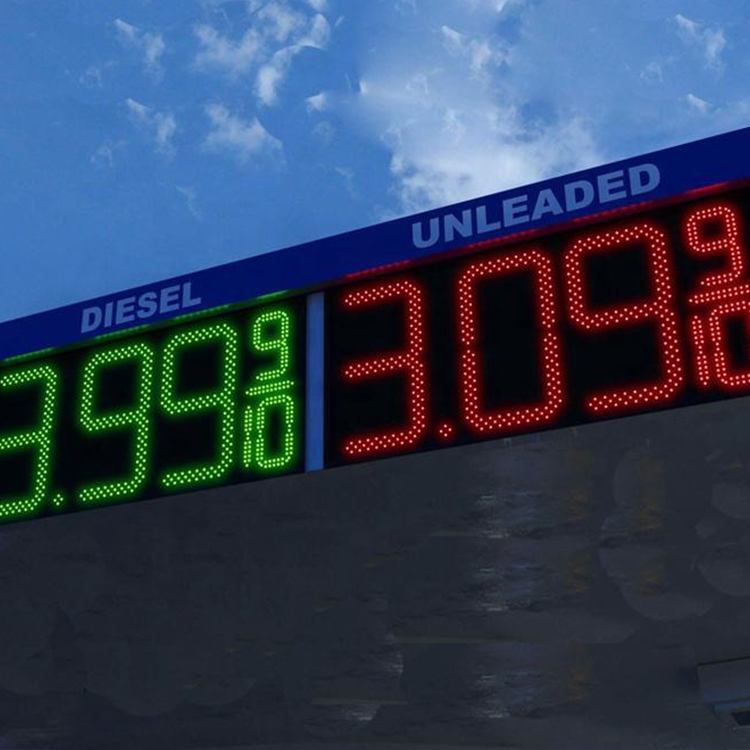
One missing segment is not cosmetic when it changes a price from 3.89 to 3.09.
Take the display out of service, blank the affected row, or use the manufacturer-approved fallback method until the price can be shown correctly. The appropriate response depends on the controller and local rules, but knowingly displaying an ambiguous price is not acceptable.
A useful service report should tell the next technician what changed, not merely prove that somebody visited.
기록:
Over time, the log reveals whether one row repeatedly loses communication, one power supply runs hotter, one cabinet face admits water, or one station experiences more surge damage than the rest of the network.
That information changes purchasing decisions.
It can also expose a bad original design.
For a new project, use the complete gas station signage buyer’s guide to define service access, component documentation, environmental limits, controls, spare parts, and commissioning requirements before the sign enters production.
The cheapest maintenance program begins during engineering.
LED gas price signs should generally receive a remote or visual check every month, a qualified hands-on preventive inspection every three months, and a full documented service once per year, with shorter intervals for coastal salt, desert dust, extreme heat, freeze-thaw cycling, repeated faults, or storm exposure.
Prices should also be verified after every change. Immediate inspection is appropriate after lightning, flooding, impact, repeated breaker trips, water entry, communication failures, or any defect that could make a displayed price inaccurate.
Quarterly LED gas price sign maintenance is a preventive service that verifies displayed prices, segment operation, brightness control, communications, power supplies, wiring, connectors, grounding, surge protection, cabinet seals, drainage, corrosion, fasteners, structural condition, and safe service access before small defects become outages.
The technician should document measurements, fault codes, photographs, replaced parts, cabinet conditions, and follow-up recommendations. Merely confirming that the sign lights up does not constitute a complete inspection.
Gas station staff may perform ground-level visual checks and manufacturer-approved exterior cleaning, but opening cabinets, testing energized circuits, replacing power supplies, adjusting internal wiring, or working from lifts should be assigned to qualified personnel following the site’s electrical isolation and fall-protection procedures.
Staff should be trained to recognize inaccurate prices, dark segments, unusual glare, water staining, burning odors, loose panels, and communication alarms. Their role is early detection, not improvised electrical repair.
An LED fuel price display needs immediate repair when any numeral is wrong or incomplete, prices differ from the pump or point-of-sale system, brightness becomes unreadable or glaring, water or corrosion appears inside the cabinet, breakers trip, burning odors occur, or communication faults repeatedly return.
Damage after lightning, flooding, high wind, vehicle impact, or cabinet penetration should also be investigated before normal operation resumes. A scheduled service date is not a reason to leave misleading or unsafe equipment operating.
An IP65 rating means an enclosure was tested for dust ingress and water jets under defined conditions, not that the installed gas price sign is permanently waterproof or maintenance-free; field wiring, cabinet doors, gaskets, drainage, penetrations, corrosion, repairs, and later cabinet openings can still create water paths.
The rating may also apply only to a module or one side of a cabinet. Buyers should confirm exactly what was tested and maintain the complete installed system accordingly.
Do not order an LED gas price display with a vague promise that it will be “easy to maintain.”
Put the requirements in writing.
Specify monthly operating checks, quarterly preventive visits, annual full service, post-storm inspections, price-verification responsibilities, electrical isolation procedures, access method, spare parts, controller backups, reporting fields, response times, and the exact components technicians must inspect.
When sourcing custom LED gas price signs, provide the installation climate, operating hours, traffic approaches, digit layout, voltage, communication method, cabinet access, brightness-control requirements, and expected maintenance resources.
Then ask the uncomfortable questions.
Where are the power supplies? Can they be replaced without removing the entire display? Are gaskets reusable? Which parts are proprietary? What happens when remote communications fail? How is water drained? Which components should be stocked locally?
A sign should not merely survive the warranty period.
It should be serviceable for years.
댓글