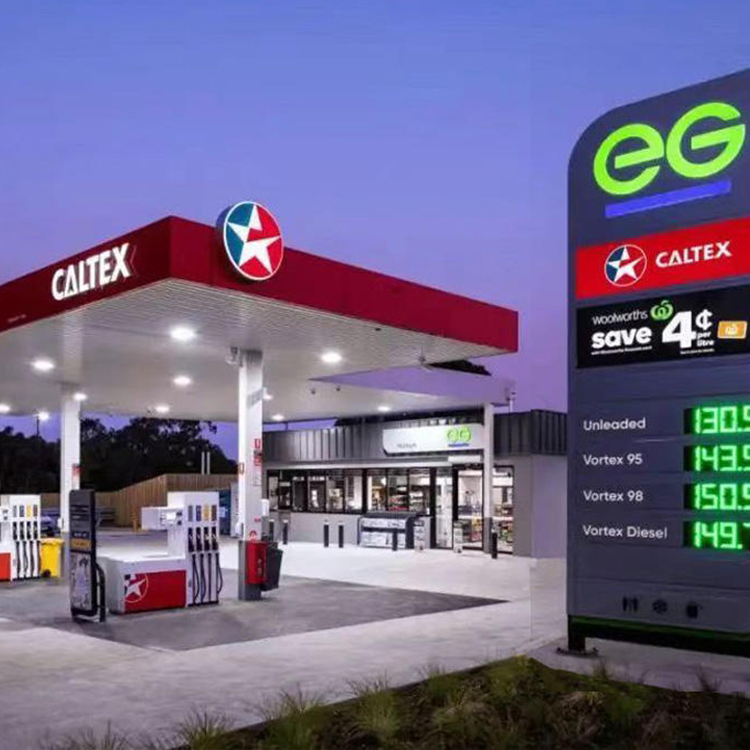
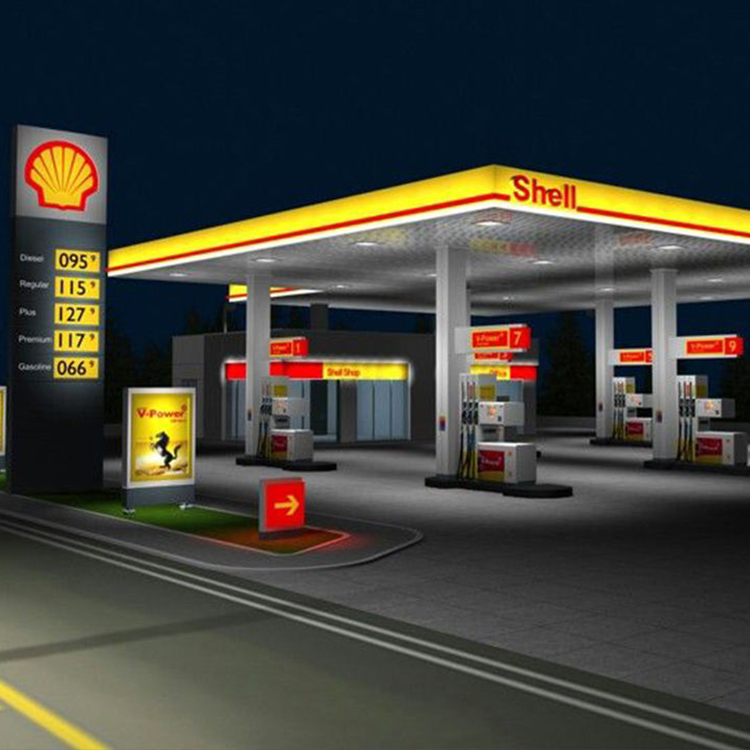
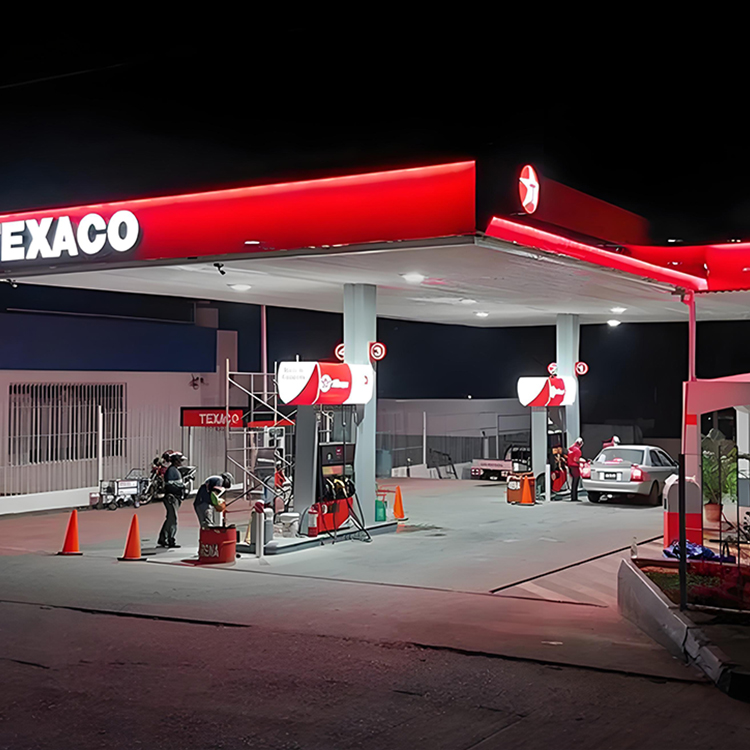
Tell us your sign type, dimensions, quantity, materials, illumination, voltage, mounting method, and delivery country. Our engineering team will review your requirements and prepare a factory quotation with recommended specifications and estimated production lead time.
Before You Leave, Get a Factory Quote
Share your drawings, dimensions, materials, quantities, illumination requirements, and delivery destination. Our signage engineering team will review your project and provide a tailored manufacturing proposal for LED letters, light boxes, pylon signs, gas station signage, or other custom sign systems.
Gas Station Canopy Fascia Materials: ACP vs Aluminum vs Acrylic
ACP is generally the best all-around material for long, opaque gas station canopy fascia, while solid aluminum offers greater material simplicity and acrylic delivers superior illuminated graphics. The strongest systems are usually hybrids: aluminum or correctly specified ACP forms the weather-resistant shell, while acrylic is limited to glowing logos, color bands, and replaceable identity panels.
Material names mislead.
A quotation that says only “ACP fascia,” “aluminum panel,” or “acrylic sign” leaves unanswered questions about core chemistry, aluminum skin thickness, alloy, coating, panel joints, expansion allowance, flame behavior, mounting rails, LED heat, drainage, and access for future repairs.
So what exactly are you buying?
The Hard Truth: ACP Is Not a Complete Material Specification
I have a simple rule when reading a gas station fascia quotation: when the bill of materials says only “4 mm ACP,” the material has not been fully specified.
ACP means aluminum composite panel. It normally consists of two thin aluminum cover sheets bonded to a central core. That core may be standard polyethylene, mineral-filled fire-retardant material, or a higher-performing low-combustibility formulation. Products that look nearly identical can behave very differently under heat.
The cover sheets also matter. A 4 mm panel with thin aluminum skins should not be treated as equivalent to a 4 mm architectural panel with 0.5 mm cover sheets. One may dent, ripple, or lose edge strength far sooner than the other.
For reference, ALUCOBOND PLUS publishes a specification of 0.5 mm aluminum cover sheets for both its 3 mm and 4 mm products. The published panel weights are 5.9 kg/m² for 3 mm and 7.6 kg/m² for 4 mm material. Those figures are not universal ACP values; they show why the brand, skin thickness, alloy, core, and test documents belong in the purchase specification.
The same discipline applies to solid aluminum and acrylic:
“Aluminum” does not state the alloy, temper, sheet thickness, reinforcing method, or paint system.
“Acrylic” does not state whether the sheet is cast, extruded, impact-modified, sign-grade, UV-resistant, translucent, or suitable for the expected operating temperature.
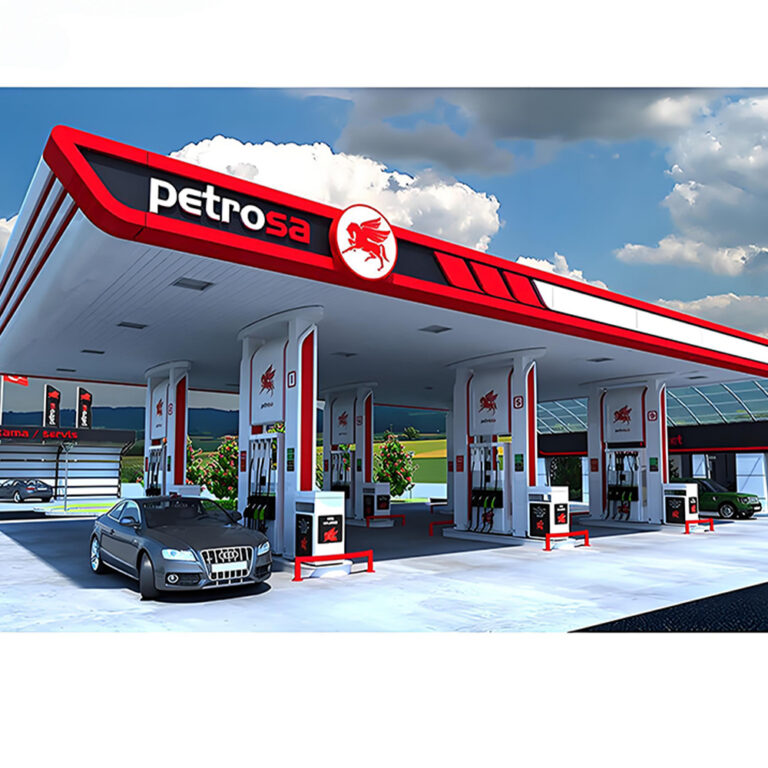
This is why a professionally engineered gas station canopy fascia system should be reviewed as an assembly—not purchased as loose square metres of colored sheet. The manufacturer’s existing canopy range includes modular fascia panels, corner sections, color bands, and illuminated identity elements that can be configured to the canopy structure and petroleum-brand drawings.
Oil-canning, corrosion at mixed-metal interfaces, weak reinforcement, coating failure
Crazing, cracking at screws, heat deformation, solvent attack, uneven illumination
My recommendation
Best default for large opaque areas when fully documented
Best for severe exposure or projects prioritizing metal construction
Use selectively for illumination, not as the entire unsupported fascia
These are procurement guidelines, not structural calculations. Wind pressure, panel span, fastening centres, canopy geometry, local code, snow, seismic forces, coastal exposure, and maintenance access still require project-specific review.
ACP Gas Station Canopy Fascia: The Sensible Default—With Conditions
ACP earns its popularity honestly. It is flat, formable, relatively light, easy to route and fold, and efficient for covering long canopy elevations. It also allows factories to produce repeatable cassettes, corner modules, color bands, access panels, and logo recesses.
For a multi-site petroleum rollout, that repeatability matters. A chain may need the same red stripe, white fascia depth, logo position, corner radius, and joint rhythm across dozens of sites. ACP can handle that without turning every location into a custom sheet-metal experiment.
But cheap ACP creates four recurring problems.
1. The Core Is Hidden After Installation
Once the panel is folded and installed, nobody standing on the forecourt can identify the core chemistry. The color may be correct while the fire documentation is not.
The 2019 Grenfell Tower Inquiry Phase 1 report found that polyethylene-core aluminum composite panels acted as a source of fuel and were the principal reason flames spread rapidly around the building. A detached fuel-station canopy is not a high-rise residential rainscreen, so the assemblies and code routes are different. Still, the lesson is impossible to ignore: “aluminum composite” describes the outer appearance, not the fire behavior of its core.
The regulatory reaction was equally direct. England introduced restrictions in December 2018 requiring A1 or A2-s1,d0 materials in the external walls of certain high-rise buildings. In 2022, the government announced a broader prohibition on unmodified polyethylene-core metal composite material in external walls of buildings regardless of height or use. These rules do not automatically apply to every gas station canopy worldwide, but they establish a clear procurement precedent: core chemistry must be declared and verified, not assumed.
My position is blunt: a fuel-site buyer should never accept “standard ACP core” as sufficient wording.
2. Total Thickness Can Hide Weak Aluminum Skins
Two panels may both be described as 4 mm ACP while using very different aluminum skin gauges. The thicker core does not automatically compensate for thin outer metal.
Thin skins are more vulnerable to:
Installation dents
Fastener pull-through
Edge damage after routing
Visible waviness under reflected light
Reduced resistance around access doors and corners
Damage during maintenance or pressure washing
The RFQ should therefore identify the total panel thickness and the minimum aluminum cover-sheet thickness.
3. The Paint System Determines Whether the Brand Still Looks Correct
Gas station fascia lives under relentless exposure: UV radiation, heat, rain, road film, fuel residues, airborne salts, cleaning chemicals, and temperature cycling.
“Red paint” is not a coating specification.
For demanding aluminum architectural surfaces, buyers often refer to performance standards such as AAMA 2605. The Fenestration and Glazing Industry Alliance describes AAMA 2605 as a specification covering test procedures and performance requirements for superior-performing organic coatings on aluminum extrusions and panels.
A proper fascia specification should state:
Coil-coated or post-painted finish
Coating system and supplier
Gloss range
Approved color reference
Acceptable production-batch variation
UV and weathering requirement
Edge-treatment procedure
Cleaning restrictions
Touch-up method
Color inconsistency is especially damaging on a rollout. Drivers may not measure a color difference, but they will notice when one station looks faded, pink, orange, or patched beside the next.
4. The Joint Design Often Matters More Than the Panel
Long fascia runs move.
ACP panels expand and contract, the steel canopy moves differently, and the sealant ages under sunlight. If the installer tries to create one visually seamless 25-metre band without planned movement, something eventually gives: the panel buckles, the joints split, the sealant tears, or the fixing holes elongate.
Good fascia engineering includes:
Module lengths suited to transport and installation
Defined open or sealed joints
Drainage paths
Oversized or slotted movement holes where appropriate
Isolating materials between dissimilar metals
Replaceable corner and logo modules
Rear access for wiring and power supplies
Service loops that do not trap water
ACP is not the problem. Incomplete detailing is.
Solid Aluminum Fascia: Stronger Material Story, Higher Fabrication Burden
Solid aluminum removes the uncertainty of a composite core. That makes it attractive for buyers who want a straightforward metal skin, stricter fire-performance positioning, or a more rugged exterior.
I would seriously consider solid aluminum for:
Coastal sites with aggressive salt exposure
High-wind locations
Low canopies exposed to vehicle or maintenance damage
Narrow fascias where heavy reinforcement is unnecessary
Projects where local authorities or insurers question composite cores
Retrofit zones around doors, hatches, drains, and impact-prone edges
But solid aluminum is not automatically flat.
Large, lightly reinforced metal sheets may show oil-canning—the visible waviness caused by residual stress, forming, thermal movement, uneven support, or installation pressure. Increasing sheet thickness can help, but so can correctly positioned stiffeners, folded returns, cassette geometry, joint spacing, and controlled fixing.
And cost behaves differently. The raw sheet may be only one part of the premium. Solid aluminum can require more forming, welding, grinding, reinforcement, surface preparation, and post-fabrication painting than ACP.
The result may be better. The invoice will usually know it.
Where Aluminum Wins
Solid aluminum performs particularly well for:
Folded corner sections
Narrow trims
Drip edges
Access doors
Logo back pans
Reinforced impact zones
Mounting rails
Non-illuminated metallic bands
For a complete gas station signage package, solid aluminum can also maintain material consistency across fascia cabinets, pylon structures, logo boxes, and directional panels. The product category covers coordinated canopy fascia, fuel-price displays, pylons, logo panels, and wayfinding for new builds and rebranding programs.
Where Aluminum Loses
Solid aluminum becomes less attractive when:
The fascia is extremely long and price-sensitive
The required finish is already available as a proven coil-coated ACP color
Complex routing and folding can be completed faster with composite panel
The installation crew is not equipped to control metal distortion
Field replacement must be quick and inexpensive
Large illuminated areas require translucent faces
My preference is not “solid aluminum everywhere.” It is solid aluminum where its extra fabrication cost solves a real exposure, fire, impact, or detailing problem.
Acrylic Canopy Fascia: Excellent for Light, Poor as a Universal Cladding Answer
Acrylic is the visually seductive option. It offers saturated color, smooth gloss, controlled translucency, thermoforming, and bright LED illumination.
That does not make it suitable for an entire unsupported canopy perimeter.
Published technical information for colorless ACRYLITE Resist reports light transmission above 91% at 1/8-inch thickness. The same technical document identifies the product as a combustible thermoplastic with a UL 94HB flammability rating and warns that it must be protected from flame and high heat sources.
That combination explains acrylic’s proper role: it is an optical sign material, not a substitute for every opaque fascia skin.
Acrylic’s Biggest Engineering Problem Is Movement
Acrylic expands far more than metal. ACRYLITE’s cast-sheet data states that the sheet can expand about three times as much as metals. Its example says a 48-inch panel may move approximately 3/16 inch across a 100°F temperature difference. The manufacturer therefore warns against rigidly bolting large sheets and recommends framed installation with adequate expansion space.
On a fuel-station canopy, the sheet may face intense daytime solar heating and rapid nighttime cooling. Darker colors absorb more heat. An installer who drills tight holes and clamps every fastener may create stress concentrations that lead to:
Cracking around screw holes
Edge chipping
Bowed faces
Stress crazing
Distorted graphics
Water entry around failed seals
Panel noise in windy conditions
Acrylic needs room to move.
Acrylic’s Best Uses
Use acrylic for:
Internally illuminated petroleum logos
Translucent corporate color stripes
Replaceable identity panels
Corner logo cubes
Directional inserts
Pump-island signs
Backlit service icons
Face panels on shallow light-box modules
The website’s outdoor acrylic canopy fascia examples reflect this modular logic: acrylic works within illuminated sign assemblies rather than acting as the entire structural canopy envelope.
Acrylic’s Worst Uses
I would challenge any proposal that uses large, flat acrylic sheets as the sole fascia material without documented framing, movement allowance, heat management, wind-load verification, access design, and fire-code review.
More light is not automatically better engineering.
The Best Material Is Usually a Hybrid System
For most modern stations, the strongest answer is not ACP versus aluminum versus acrylic. It is ACP plus aluminum plus acrylic, with each material assigned the job it handles best.
A practical hybrid build may use:
Galvanized steel or aluminum support framing for the mounting structure.
FR or approved-core ACP cassettes for long opaque brand-color bands.
Solid aluminum trims and corners where edge strength and clean detailing matter.
Acrylic sign-grade faces for illuminated logos and translucent inserts.
Serviceable LED modules and power supplies behind removable identity panels.
Separate gas price and pylon systems coordinated to the same brand standards.
This approach also simplifies maintenance. When an illuminated logo is damaged, the operator replaces the logo module rather than dismantling the entire fascia. When a color band changes during rebranding, the opaque cassette can be replaced without rebuilding the support structure.
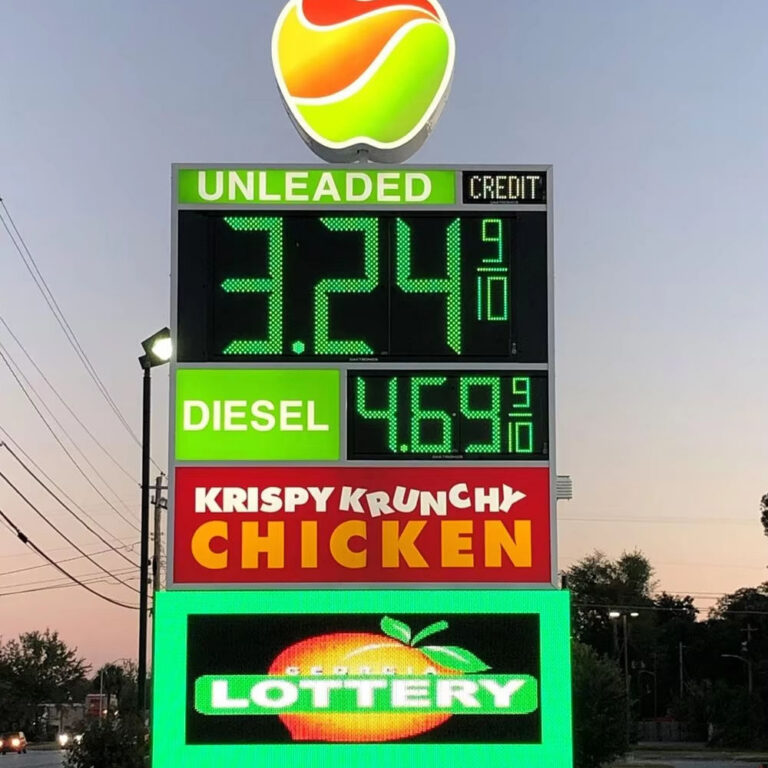
The same design logic should continue from the canopy to the LED gas price signs and gas station pylon signs. A station looks coordinated only when panel colors, logo proportions, LED color temperature, cabinet depths, corner details, and installation heights are controlled as one identity system.
Which Material Should You Choose for Each Site?
Choose FR or Approved-Core ACP When:
You need long, flat, opaque fascia bands.
Rollout consistency matters across multiple stations.
Installation weight must stay manageable.
Folded cassettes and modular replacement are priorities.
The core, aluminum skins, coating, and certifications can be documented.
The local authority accepts the proposed assembly.
My default specification would be a clearly identified exterior-grade panel—not generic “ACP”—with declared core composition, minimum skin thickness, approved coating, shop drawings, joint design, and traceable batch information.
Choose Solid Aluminum When:
The project places a premium on non-composite metal construction.
Coastal corrosion, wind, impact, or vandalism risk is high.
The fascia includes many corners, trims, doors, or reinforced details.
A premium post-painted finish is required.
The budget supports additional fabrication and finishing.
The fabricator can control oil-canning and thermal movement.
Choose Acrylic When:
The component must transmit or diffuse light.
The logo requires saturated corporate color.
The panel is properly framed and replaceable.
Expansion gaps are built into the mounting method.
LED heat and ventilation have been reviewed.
The sheet grade is approved for outdoor sign use.
Choose a Hybrid When:
The station requires both long opaque bands and illuminated brand elements.
Maintenance access matters.
Different façade zones have different impact and fire requirements.
A chain needs a repeatable system for future rebranding.
You want to avoid forcing one material to perform three incompatible jobs.
For most commercial projects, hybrid wins.
What a Serious Canopy Fascia Specification Should Contain
A buyer should be able to issue the following information before approving production.
Panel and Metal Requirements
Material type for every fascia zone
Manufacturer and model, or approved equivalent
Total panel thickness
Aluminum skin thickness for ACP
Core type and fire classification
Solid aluminum alloy, temper, and thickness
Acrylic type, color, transmission, and thickness
Interior and exterior surface finishes
Coating standard and warranty requirement
Structural and Installation Requirements
Canopy elevations and surveyed dimensions
Design wind load
Support-frame material
Fastener type and spacing
Dissimilar-metal isolation
Joint width and layout
Expansion allowance
Corner construction
Drainage and ventilation
Access-panel locations
Cable routes and earthing details
Installation responsibility
Illumination Requirements
Logo brightness target
LED module brand and model
Module spacing
Operating voltage
Power-supply model
Surge protection
Cable specification
Ingress-protection requirement
Heat-dissipation method
Service access
Nighttime prototype or illumination test
Custom Signage Factory states that applicable illuminated projects can be configured with IP68 LED modules rated up to 110 lm/W and IP65 Mean Well power supplies, subject to the approved bill of materials. Those numbers should still be written into the project documents when required; capability statements are not substitutes for a signed BOM.
Approval and Quality-Control Documents
Brand color references
Vector artwork
Approved shop drawings
Material data sheets
Fire and electrical certificates where applicable
Physical color sample
First-article sample
Welding and frame details
LED layout drawing
Inspection checklist
Packing schedule
Location-specific identification labels
For outsourced production, the OEM and ODM signage process records agreed materials, finishes, lighting, mounting, and electrical configuration before manufacturing. The company’s commercial signage case studies also outline a workflow covering project requirements, engineering, fabrication, LED integration, inspection, and export packing.
The Cheapest Panel Rarely Produces the Cheapest Fascia
Procurement teams often compare material prices per square metre. That is understandable—and incomplete.
The color does not match the approved brand sample.
The core certificate cannot be verified.
The corner geometry does not fit the surveyed canopy.
Panels are too long for the container or local lifting equipment.
Acrylic cracks because the fixing holes provide no movement.
Power supplies are sealed behind non-removable panels.
One failed logo requires dismantling ten metres of fascia.
Replacement material comes from a different color batch.
Here is my controversial opinion: procurement departments should stop asking only, “What is your ACP price?” and start asking, “What exactly remains serviceable after year five?”
That question exposes weak systems quickly.
FAQs
What is the best material for gas station canopy fascia?
The best gas station canopy fascia material is usually an exterior-grade, fully documented ACP system for long opaque areas, combined with solid aluminum for reinforced details and acrylic for illuminated logos. This hybrid arrangement balances flatness, weight, fabrication cost, visual performance, maintenance access, and material-specific movement better than a one-material design.
ACP should include a declared core, aluminum skin gauge, exterior coating, joint design, and supporting test documents. The final selection must also account for local fire rules, wind loads, corrosion exposure, canopy geometry, and the petroleum brand’s identity standards.
Is ACP safe for gas station canopy cladding?
ACP can be appropriate for gas station canopy cladding when its core composition, aluminum skin thickness, coating, test classification, mounting system, and intended application are clearly documented and accepted by the relevant authority. The term “ACP” alone does not establish fire performance because visually similar panels may contain very different polymer or mineral-filled cores.
Buyers should reject vague descriptions such as “normal core” or “standard fireproof panel.” Request the product model, manufacturer, core declaration, test report, traceable labeling, and confirmation that the complete installation complies with local requirements.
Can acrylic be used for the entire petrol station canopy fascia?
Acrylic should normally be used for illuminated logos, translucent stripes, and replaceable identity panels rather than as the entire unsupported petrol station canopy fascia. Its strong light transmission and weatherable appearance suit illuminated branding, but its combustible nature, higher thermal expansion, heat sensitivity, and risk of stress cracking demand framed, ventilated, movement-tolerant construction.
Large acrylic panels require engineered support, oversized mounting allowances, correct gaskets, compatible sealants, and adequate ventilation around LEDs. Treating acrylic like a rigid metal panel is one of the fastest ways to create cracks and warped faces.
Is solid aluminum better than ACP for canopy fascia?
Solid aluminum is better than ACP when a project prioritizes metal-only construction, reinforced edges, impact resistance, difficult corner details, severe coastal exposure, or stricter control over combustible cores. However, it usually requires more forming, stiffening, welding, finishing, and oil-canning control, so it is not automatically the most economical choice for long fascia runs.
ACP often provides better flatness-to-weight efficiency for large opaque surfaces. Solid aluminum earns its premium when its specific advantages solve a documented site problem, not when it is selected merely because “metal sounds stronger.”
What information should I send for a canopy fascia quotation?
A complete canopy fascia quotation request should include site dimensions, elevation drawings, photographs, fascia depth, quantity, material preferences, brand colors, illuminated areas, voltage, mounting conditions, wind-load requirements, destination, and applicable compliance standards. Providing vector logos, existing structural drawings, brand manuals, and required completion dates will significantly reduce assumptions and quotation revisions.
Also identify whether the project is new construction, a brand conversion, or replacement work. Existing canopy dimensions are often irregular, so surveyed measurements and corner photographs can prevent costly fit-up problems during installation.
How should ACP, aluminum, and acrylic be combined in one fascia system?
ACP, aluminum, and acrylic should be assigned separate functions: ACP for long opaque cladding cassettes, solid aluminum for frames, trims, corners, access panels, and high-abuse zones, and acrylic for illuminated faces. Each material must retain its own expansion allowance, fastening method, coating requirement, ventilation strategy, and replacement path within the complete assembly.
This modular approach allows damaged or outdated brand elements to be replaced independently. It also prevents large translucent panels from carrying structural duties they were never intended to perform.
Request a Material-Specific Canopy Fascia Quote
Do not request “a price for 4 mm ACP” and hope the missing details sort themselves out later.
Send your canopy dimensions, elevations, site photographs, brand files, required colors, illuminated zones, voltage, destination country, wind conditions, preferred fire classification, and installation method through the Custom Signage Factory contact page.
Ask for a quotation that identifies the ACP core, skin thickness, aluminum specification, acrylic grade, coating system, LED configuration, joint layout, access method, packing plan, and production lead time. That is how you compare real systems—not misleading square-metre prices.
Custom Signage Factory manufactures commercial signs for sign companies, contractors, distributors, and multi-site brands. With a 20,000 m² workshop, 80+ production workers, 50+ machines, and an annual capacity of 100,000 pieces, we produce LED letters, light boxes, pylon signs, gas station signage, neon signs, and custom OEM sign systems.