Tell us your sign type, dimensions, quantity, materials, illumination, voltage, mounting method, and delivery country. Our engineering team will review your requirements and prepare a factory quotation with recommended specifications and estimated production lead time.
Before You Leave, Get a Factory Quote
Share your drawings, dimensions, materials, quantities, illumination requirements, and delivery destination. Our signage engineering team will review your project and provide a tailored manufacturing proposal for LED letters, light boxes, pylon signs, gas station signage, or other custom sign systems.
An LED fuel price display receives a price command, translates each number into a seven-segment lighting pattern, and sends controlled electrical current to the appropriate LED segments. A complete system usually includes numeric modules, a controller, LED drivers, power supplies, communication hardware, ambient-light sensing, weatherproof cabinets, and a roadside sign structure.
Prices move fast.
Although the finished display may show nothing more complicated than “3.89,” the system behind those three digits must maintain readable brightness in direct sunlight, survive rain and dust, accept secure price changes, preserve the last valid value after a power interruption, and match the commercial price customers actually receive at the pump.
So why are buyers still comparing these systems by digit height and cabinet price alone?
The easiest way to understand an LED fuel price display is to follow the information from the station manager to the roadside pylon.
The signal path normally looks like this:
An operator enters a new fuel price.
A remote, computer, or site controller sends the command.
The display controller identifies the correct fuel row.
The controller converts the price into segment instructions.
LED driver circuits energize the required segments.
A light sensor or programmed schedule sets the brightness.
The displayed value is stored until another valid command arrives.
Every stage matters. A display with excellent LEDs but an unreliable controller is still unreliable. A powerful remote is useless when the receiver is buried inside a poorly designed metal enclosure. And an IP67 digit module does not make the entire pylon IP67.
Seven Segments Create Every Number
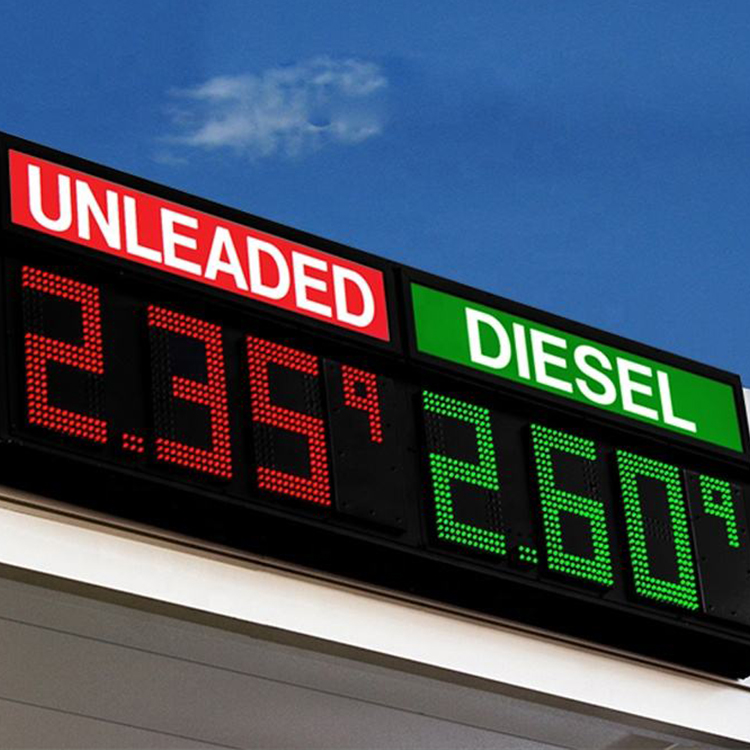
Most electronic gas station price signs do not use a full video screen. They use seven-segment numeric modules because the application only needs numbers, decimal points, and occasionally a fractional digit.
Each numeral contains seven illuminated bars, conventionally identified as segments A through G:
The number 1 uses two segments.
The number 4 uses four segments.
The number 8 activates all seven.
A separate LED point or smaller module may represent the decimal or traditional nine-tenths fraction.
This architecture is simple, bright, and serviceable. One failed segment is immediately visible, however. A damaged segment can turn an 8 into a 9, a 6 into a 5, or a 3 into something drivers cannot confidently read.
That is not merely cosmetic. It can create a pricing dispute.
The site’s 12-inch modular LED gas price panel is one example of this architecture, combining seven-segment digits with IP65 protection, listed brightness options of 2,500, 3,000, or 3,500 cd, and remote device management. Buyers should still ask how brightness was measured, because “cd” and “cd/m²” describe different photometric quantities.
The Controller Decides What Each Row Shows
The controller is the system’s brain. It receives a value such as:
Regular = 3.899
It then determines:
Which row represents regular gasoline
Which digits must change
Whether a decimal or fractional digit is required
Which display face must receive the command
Whether the instruction is valid
Whether the previous value should be retained if communication fails
In a basic standalone system, the controller may communicate only with a handheld RF remote. In a more advanced installation, it may receive data from local management software, a price server, a point-of-sale system, or a multi-site corporate platform.
Here is the hard truth: “remote controlled” does not automatically mean “integrated.”
A handheld remote may change the roadside price while leaving the dispenser or point-of-sale price untouched. Genuine synchronization requires a documented connection between the pricing database, pump controller, point-of-sale system, and sign controller.
LED Drivers Regulate the Electrical Load
The controller does not normally power every LED directly. Driver circuits switch the required segments and regulate current through the LEDs.
A well-designed driver system must handle:
Different segment lengths
Voltage variation
Heat generated inside the module
Day and night brightness levels
Single- and double-sided configurations
Temporary communication interruptions
Electrical surges and switching noise
Pulse-width modulation, commonly called PWM, may be used to control apparent brightness by switching the LEDs on and off rapidly. The human eye sees a stable digit, while the controller changes the percentage of time the LEDs remain energized.
Poor PWM implementation can create visible flicker in mobile-phone photographs or video. More seriously, an under-specified driver may overdrive the LEDs during hot daytime conditions, producing early lumen loss or color inconsistency.
Power Supplies Convert the Site Voltage
The display may receive 110V or 220V AC, but the LED modules and controllers usually operate at lower DC voltage. Power supplies convert the incoming electricity and distribute it to the display components.
A published RF-controlled LED gas price sign configuration, for example, lists 110/220V AC at 50–60Hz, a 30–100 metre RF control range, eight-level automatic dimming, 3,000 cd listed brightness, and IP67 sealed digit modules.
I would never approve a project from those headline numbers alone. I would also request:
Power consumption per digit and per complete row
Maximum startup current
Power-supply brand and model
Surge-protection arrangement
Grounding method
Cable size and connector specification
Operating-temperature range
Replacement power-supply availability
Electrical certification required in the installation country
For U.S. projects, UL identifies UL 48 for electric signs, UL 879 for electric-sign components, UL 879A for LED sign and retrofit kits, and NEC Article 600 among the common standards and requirements buyers may need to address. UL’s electric sign certification guidance is a more useful starting point than a vague supplier statement that a sign is “UL compatible.”
What Happens When a Station Updates Its Fuel Price?
Consider a station changing regular gasoline from $3.79⁹ to $3.84⁹.
Step 1: The Operator Selects the Correct Price Row
The operator chooses the fuel grade, display address, or row number. In a small station, that may happen on a handheld remote. In a chain, the update may begin inside a central pricing system.
Selecting the wrong address can change premium instead of regular, or one face of a double-sided sign instead of both.
Step 2: The New Price Is Encoded
The control device converts the entered price into a digital command. Depending on the system, that command may include:
Device address
Fuel-row address
Numeric value
Decimal or fraction configuration
Brightness instruction
Error-checking data
Confirmation request
A serious buyer should ask for the actual communication protocol. Proprietary systems can work well, but they can also lock the station into one controller supplier for every future repair.
Step 3: The Command Travels to the Sign
Common communication methods include:
RF handheld remote
Hardwired serial communication
Ethernet
Wi-Fi
Cellular connection
Central cloud or network management
RF is attractive because it avoids trenching or new data cabling. But radio performance depends on distance, antenna placement, metal obstruction, local interference, and whether the transmitter is legally authorized for the destination market.
The U.S. Federal Communications Commission states that an RF device must follow the appropriate equipment-authorization procedure before it is marketed, imported, or used in the United States. A supplier saying “433 MHz remote” or “long-range wireless” is not the same as supplying valid FCC documentation. FCC equipment authorization guidance should be checked when RF hardware is included.
Step 4: The Controller Validates the Message
The display controller checks whether the message belongs to that unit and whether the data format is acceptable.
A better system will reject incomplete or corrupted commands rather than displaying partial numbers. It may also send an acknowledgement back to the operator.
This distinction matters. A remote showing “send successful” may only mean that the handset transmitted a signal. It does not necessarily prove that every display face changed correctly.
Step 5: The Driver Changes Only the Required Segments
When 3.79 changes to 3.84, the controller does not need to rebuild a full graphic image. It switches the segment pattern for the affected digits.
The update should appear nearly instantaneously. Some controllers briefly blank the row during the change; others switch directly from the old number to the new one.
Step 6: The Display Stores the New Value
The controller typically retains the value in non-volatile memory. After a short power interruption, the sign should restore the last approved price instead of showing zeros, random digits, or a factory default.
Ask the supplier what happens after:
Loss of AC power
Controller restart
Communication failure
Sensor failure
One missing digit module
Corrupted memory
Replacement of the main controller
These are not theoretical questions. They determine what motorists see at 2:00 a.m. after a thunderstorm.
How LED Fuel Price Displays Work
Standalone, RF, and Networked Price-Control Systems Compared
Control architecture
How prices are updated
Main advantage
Main weakness
Best application
Manual number panels
Staff physically replace number tiles
Low electronic complexity
Slow, labour-intensive, and risky at tall pylons
Low-change locations or backup signage
Standalone RF controller
A handheld remote sends prices directly to the sign
Fast installation with limited data cabling
Does not automatically synchronize pumps or POS systems
Independent stations and retrofit projects
Wired local controller
A cable connects the office controller and roadside display
Stable communication and lower RF interference risk
Trenching and cable routing may increase installation cost
New-build stations and compact sites
Networked site system
Local software manages several price rows or signs
Better logging and coordinated updates
Requires compatible software and network support
Large forecourts and service areas
Central multi-site platform
Corporate pricing data is distributed to many locations
Consistent regional updates and audit control
Integration, cybersecurity, and vendor-lock-in risks
Petroleum chains and multi-location operators
The “best” system is not always the most connected one. An independent station may get better reliability from a simple RF system with a spare controller than from a cloud platform nobody on site knows how to troubleshoot.
But for a 200-site network, asking managers to update every pylon manually is an invitation to pricing inconsistency.
Automatic Brightness Control Is Not an Optional Extra
An outdoor electronic gas station price sign must work under two opposite conditions.
At midday, the digits compete with direct sunlight, reflected glare, bright canopy surfaces, and a driver’s limited viewing time. At night, the same output can become uncomfortable, create blooming around the numerals, and attract complaints from neighbouring properties.
Automatic brightness control uses an ambient-light sensor to select a suitable output level. A listed IP67 modular LED fuel price display with automatic brightness control offers more than eight adjustment levels and digit heights from 6 to 72 inches. That range illustrates why brightness, digit size, and viewing distance must be specified together rather than treated as independent options.
A few things regularly go wrong:
The sensor faces the wrong direction.
Canopy lighting shines directly onto the sensor.
Dirt makes the sensor believe it is always dark.
The minimum night setting remains too bright.
Both faces of a pylon use one sensor despite different exposure.
The controller jumps abruptly between brightness levels.
I prefer a system with automatic sensing plus manual minimum and maximum limits. That prevents a badly positioned sensor from driving the display to an unusable extreme.
Digit Height Is Only One Part of Roadside Readability
Buyers often begin with a statement such as, “We need 12-inch digits.”
That is not a complete specification.
Readable pricing depends on:
Approach speed
Viewing distance
Viewing angle
Number of price rows
Digit stroke width
Spacing between digits
Background contrast
LED colour
Daytime luminance
Nighttime dimming
Nearby advertising clutter
Sign height and orientation
A 12-inch digit on a dark, uncluttered face may outperform an 18-inch digit squeezed between fuel labels, promotional panels, and oversized brand graphics.
And more brightness is not always better. Excessive output can make segments appear thicker, cause optical blooming, and reduce the clarity of decimal points or nine-tenths fractions.
The better procurement question is not, “How bright is the display?”
It is: “Can you provide a readable, measured result at our required approach distance, viewing angle, day condition, and night condition?”
Fuel-Price Volatility Makes Fast Updating an Operational Requirement
The economic case for remote updating is straightforward.
The U.S. Energy Information Administration’s weekly series shows regular gasoline rising from $2.779 per gallon on January 12, 2026, to $4.500 on May 11—a 61.9% increase—before falling to $3.831 by June 29, a decline of approximately 14.9% from the May peak.
That does not mean every station changed its price by the national average or on the same day. It does show why a price sign cannot be treated as permanent artwork.
In 2025, the national annual average was $3.10 per gallon, but regional averages ranged from $2.39 on the Gulf Coast to $4.32 on the West Coast. The same EIA analysis recorded an annual high of $3.24 and a late-December low of $2.81.
A station may need to react to wholesale rack prices, local competitors, tax changes, supply disruptions, loyalty discounts, cash-versus-credit policies, or corporate pricing instructions. The operational cost of changing the sign therefore includes more than labour. It includes delay, inconsistency, safety exposure, and the commercial risk of displaying the wrong number.
The Roadside Sign Does Not Replace the Pump Price
This distinction is frequently misunderstood.
The roadside LED display is an advertising and customer-information device. The dispenser is the commercial measuring and transaction device.
The 2026 NIST Handbook 44 section for liquid-measuring devices states that retail dispensers must display applicable unit prices and identify the product, grade, brand, blend, or mixture being delivered. In other words, installing a digital pylon does not remove the need for correct price information at the dispenser.
The roadside value, pump setting, point-of-sale database, receipt, and payment conditions should be treated as one controlled pricing system—even when they use separate hardware.
A mismatched pylon and dispenser is not just embarrassing. Depending on the jurisdiction, it may become a consumer-protection or weights-and-measures matter.
Cash, Credit, Loyalty, and Debit Prices Must Be Designed Into the Layout
One of the worst procurement mistakes is approving a display with space for one price and discovering later that local law requires two prices or additional payment-condition wording.
Maryland’s motor-fuel signage bulletin, effective October 1, 2024, requires the higher credit and debit price to be displayed when it exceeds the cash price, while the lower cash price may also be shown. It also specifies uniform numerals at least 8 inches high, 3.5 inches wide, and with a minimum 1-inch stroke. Maryland Technical Bulletin No. 49 makes the point bluntly: legal requirements can dictate the physical design of the display.
That is why “cash,” “credit,” “member,” “with wash,” “full service,” and loyalty-program conditions cannot be added as tiny stickers after the pylon has been built.
They need allocated space, readable typography, correct hierarchy, and a control method that prevents the conditional price from being separated from its condition.
A $409.3 Million Warning About Price Disclosure
The legal risk is not hypothetical.
In the Oregon litigation Scharfstein v. BP West Coast Products, LLC, an appellate opinion contained in the U.S. Supreme Court docket described an amended trial-court judgment awarding $409.3 million in statutory damages to a class of 2,046,500 members. The dispute involved a 35-cent debit-card fee that was not disclosed as a condition on the street price sign.
The Oregon appellate court concluded that the debit fee affected the effective per-gallon price and therefore had to be disclosed. In the court’s example, adding a $0.35 fee to a $5 purchase of two gallons increased the effective price from $2.50 to approximately $2.67 per gallon.
I am not suggesting every sign error creates nine-figure liability. It does not.
But the case destroys the lazy idea that payment-condition wording is a minor graphic-design detail.
An IP67 digit module and an IP53 cabinet can exist in the same product. The module may survive exposure while the surrounding cabinet offers a lower protection level.
The complete installation also includes:
Access doors
Hinges
Seals
Cable glands
Ventilation paths
Drain holes
Connectors
Mounting penetrations
Field wiring
One badly fitted cable gland can defeat an otherwise well-sealed assembly.
I would ask for the rating of each major assembly, not one IP number copied across the entire quotation. I would also ask whether the rating is based on independent testing, a component certificate, or the supplier’s own design statement.
How LED Fuel Price Displays Work
Common Failure Modes Buyers Should Plan For
One Segment Stops Working
Possible causes include a failed LED string, damaged driver output, loose connector, water intrusion, or cracked solder joint.
The display may still illuminate, but the number becomes ambiguous.
One Face Updates and the Other Does Not
Double-sided signs may use separate controllers, receiver addresses, cables, or power branches. The operator needs confirmation that both sides received the command.
The Sign Is Visible at Night but Weak in Sunlight
This can result from insufficient daytime output, excessive face reflection, poor LED colour selection, aged LEDs, dirty lenses, or an incorrectly configured light sensor.
The Sign Is Too Bright at Night
The sensor may be blocked, incorrectly positioned, or limited by a minimum brightness setting that remains too high.
The Remote Works Only Near the Pylon
Metal construction, antenna placement, interference, weak batteries, or an unrealistic advertised range may be responsible.
Prices Return to Zero After Power Loss
The controller may lack non-volatile storage, have corrupted memory, or be configured to load a default value instead of the last approved price.
Replacement Parts Do Not Match
A new controller may use a different protocol, connector, address format, voltage, or brightness algorithm. This is why spare-part compatibility belongs in the purchase contract.
What Professional Buyers Should Put in the RFQ
I recommend specifying the complete operating system, not merely “LED gas price sign.”
RFQ item
What the buyer should define or request
Price format
Gallons or litres, decimal format, nine-tenths digit, currency convention
Fuel rows
Number of grades, cash/credit rows, diesel, loyalty or wash conditions
Covered components, labour exclusions, return process, response time
For custom projects, the manufacturer’s OEM and ODM signage engineering service can be used to review dimensions, voltage, materials, mounting, LED configuration, drawings, and repeat-order documentation before production. The important part is converting every assumption into an approved drawing, bill of materials, or written performance requirement.
FAQs
How do LED fuel price displays work?
An LED fuel price display receives a numeric price from a remote, local controller, or networked management system, converts that value into seven-segment commands, drives the required LED segments, and adjusts their brightness so motorists can read the price clearly during daytime, nighttime, and changing weather conditions.
The controller stores the last valid price and assigns values to specific rows, grades, or sign faces. Better systems also return an update confirmation and report faults.
How are digital gas station prices updated?
Digital gas station prices are updated by sending a new value to the display controller through an RF handheld remote, wired serial connection, local software interface, Ethernet, Wi-Fi, or cellular network, after which the controller validates the command, stores the price, and refreshes the assigned display row.
A standalone remote normally changes only the sign. Automatic synchronization with pumps and point-of-sale systems requires compatible integration and documented data exchange.
What is a seven-segment LED gas price display?
A seven-segment LED gas price display is a numeric module built from seven illuminated bars that can be switched in different combinations to form the digits zero through nine, with additional elements commonly used for decimal points, currency formats, or the fractional nine-tenths digit traditionally shown in gasoline pricing.
Seven-segment modules are usually less complex and more power-efficient than full-colour video screens for fixed numeric pricing.
How bright should an outdoor LED fuel price sign be?
The correct brightness for an outdoor LED fuel price sign is the level that preserves strong numeral contrast at the required viewing distance and angle without becoming dazzling at night, so the specification should combine measured luminance, digit dimensions, ambient-light conditions, dimming performance, background reflectance, and local sign-code limits.
A single maximum-brightness number is not enough. Buyers should request daytime and nighttime performance data plus automatic dimming limits.
Are IP65 or IP67 fuel price displays waterproof?
An IP65 or IP67 rating describes a tested level of enclosure protection against dust and water, but it does not automatically prove that the complete sign, pylon, access door, cable gland, power compartment, connector system, and field installation share the same rating or will remain protected after maintenance.
Ask which individual assemblies were rated, how testing was performed, and whether installation penetrations affect the declared protection level.
Can an LED gas price sign synchronize with the pumps?
An LED gas price sign can synchronize with pumps when the sign controller, point-of-sale platform, dispenser controller, and pricing database support a compatible integration that distributes one approved value to every endpoint and verifies successful updates, rather than relying on separate manual entries at the office, roadside sign, and dispenser.
Compatibility should be confirmed by system model and protocol. Do not accept “POS ready” without interface documentation and a defined commissioning test.
Specify the Complete System Before Requesting a Price
The best LED fuel price display is not the one with the highest brightness claim, tallest digit, or longest theoretical remote range. It is the system that displays the correct price, remains readable in the real installation environment, survives outdoor exposure, complies with local rules, and can still be serviced five years later.
Send the project team:
Pylon drawing or site elevation
Required number of price rows
Fuel grades and payment conditions
Digit height and viewing distance
Single- or double-sided configuration
Local voltage and frequency
Preferred control method
Required certifications
Installation country
Quantity and rollout schedule
Then request an address map, wiring diagram, component list, brightness-control logic, communication protocol, compliance documents, and spare-parts proposal.
To develop a project-specific configuration, submit these details through the custom signage factory quotation page and request an engineering review before the cabinet, controller, and display modules are released for production.
Custom Signage Factory manufactures commercial signs for sign companies, contractors, distributors, and multi-site brands. With a 20,000 m² workshop, 80+ production workers, 50+ machines, and an annual capacity of 100,000 pieces, we produce LED letters, light boxes, pylon signs, gas station signage, neon signs, and custom OEM sign systems.