Tell us your sign type, dimensions, quantity, materials, illumination, voltage, mounting method, and delivery country. Our engineering team will review your requirements and prepare a factory quotation with recommended specifications and estimated production lead time.
Before You Leave, Get a Factory Quote
Share your drawings, dimensions, materials, quantities, illumination requirements, and delivery destination. Our signage engineering team will review your project and provide a tailored manufacturing proposal for LED letters, light boxes, pylon signs, gas station signage, or other custom sign systems.
Gas Station Canopy Lighting and Signage Integration Guide
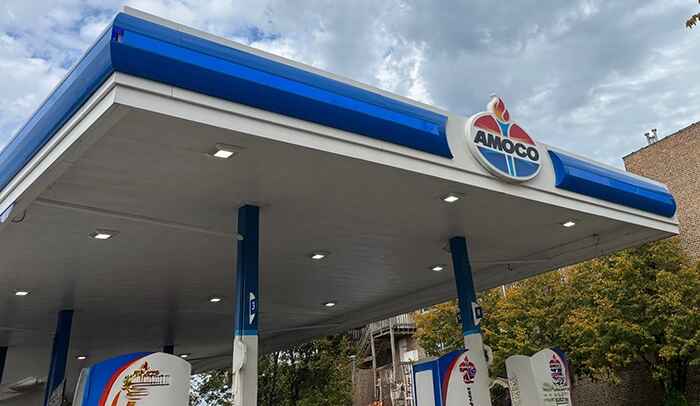
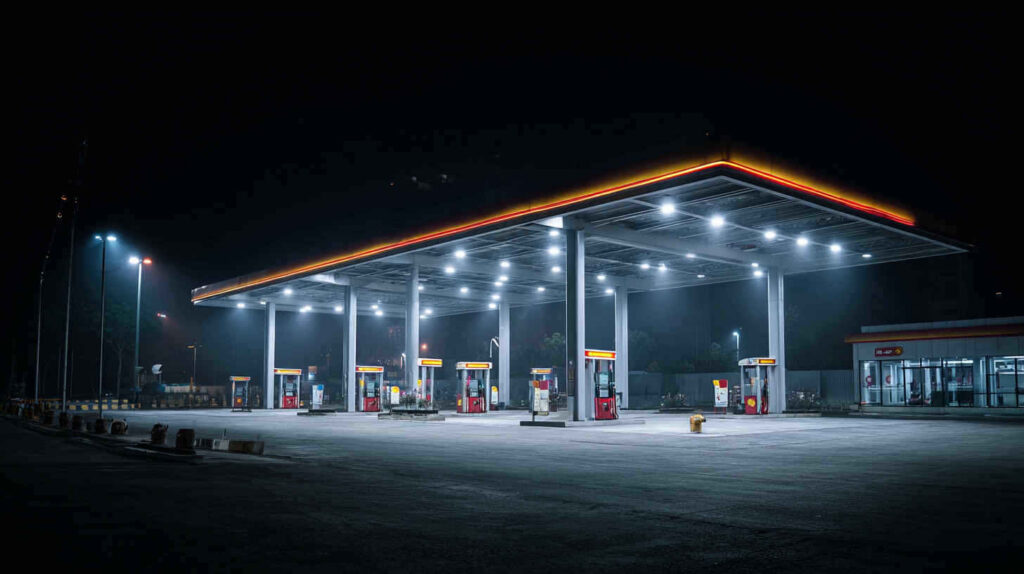
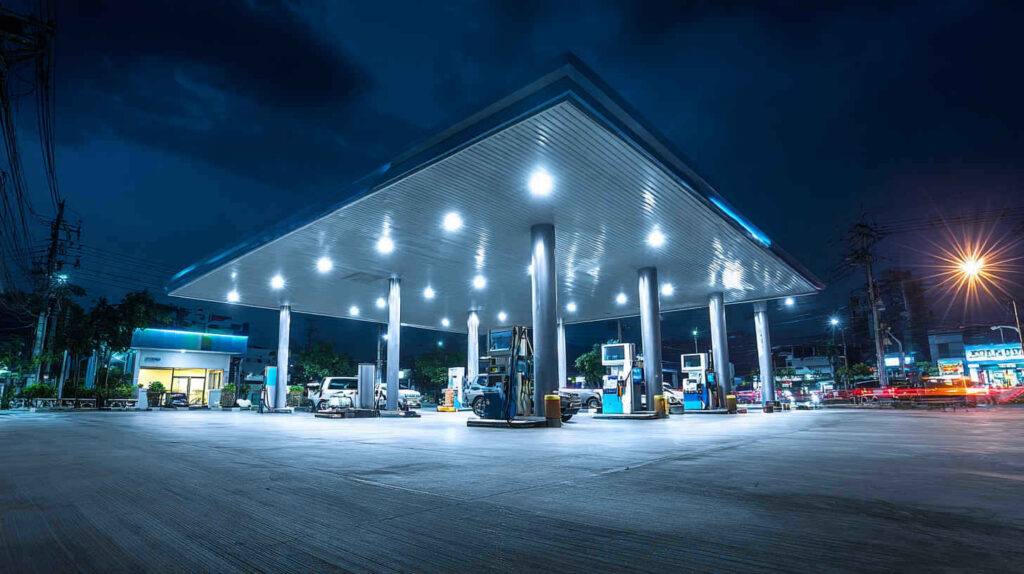
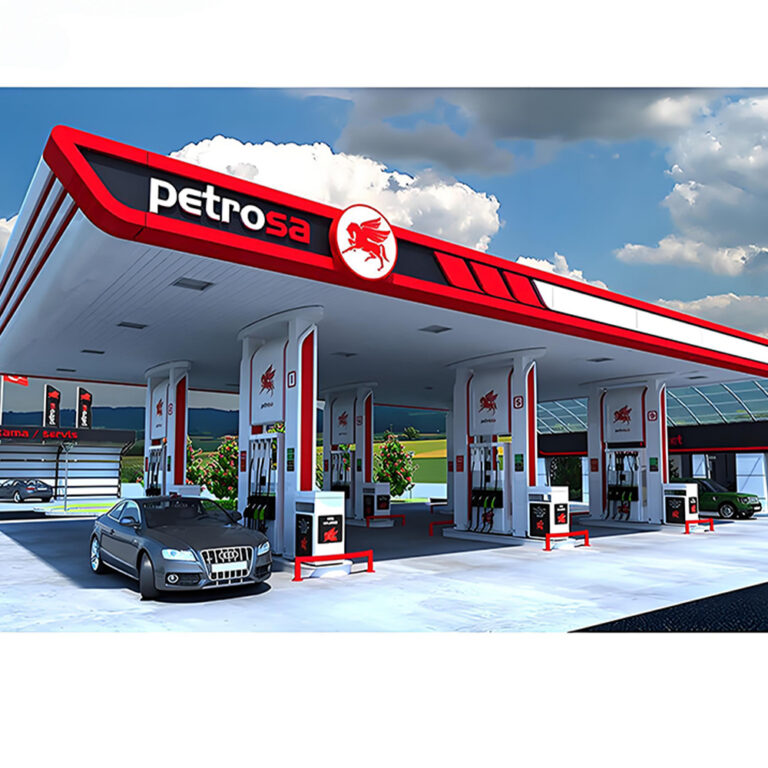
Gas station canopy lighting and signage integration is the coordinated design of downlights, illuminated fascia, logos, price communication, controls, wiring, and structural mounting as one forecourt system. Done correctly, it improves nighttime visibility, protects brand color, limits glare, reduces wasted power, simplifies maintenance, and prevents expensive conflicts during installation.
Coordination beats brightness.
A canopy can meet a nominal illuminance target and still look terrible from the road because the downlights overpower the logo, the fascia white appears blue, the price sign competes with the fuel brand, or uncontrolled glare hides pedestrians and pump details instead of revealing them.
What good is more light if the customer sees less?
A Gas Station Canopy Is One Visual System
The hard truth is that many canopy projects are purchased as three unrelated packages:
A lighting contractor supplies the canopy luminaires.
A sign company supplies the illuminated fascia and logos.
Another vendor supplies the pylon and fuel-price display.
Each vendor may deliver a functional product. Yet the completed site can still fail visually and electrically because nobody owns the complete nighttime image.
We treat the forecourt as one visual hierarchy:
The pylon identifies the station from the road.
The canopy establishes the brand at medium distance.
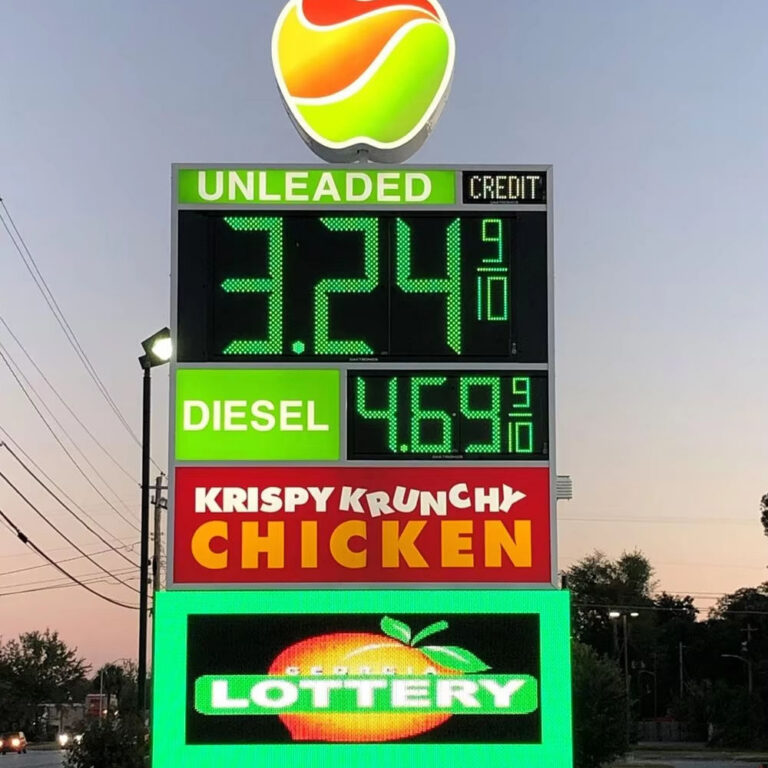
The fuel-price display communicates price information.
The downlights reveal vehicles, people, pumps, pavement, and payment areas.
Directional signs guide traffic without competing with the primary identity.
A coordinated package may combine complete gas station signage systems, canopy illumination, price communication, and wayfinding, but the relationship among those elements matters more than the number of products installed.
The strongest station is rarely the brightest station. It is the station where the customer can understand the site in two or three seconds while approaching at road speed.
Build the Photometric Plan Before Selecting Sign Hardware
A professional gas station canopy design should begin with geometry and photometrics, not a fixture catalog.
We need the canopy height, bay dimensions, dispenser positions, column locations, soffit finish, neighboring properties, road approach angles, pylon location, fascia depth, logo placement, and maintenance access before specifying LED gas station canopy lights.
Map the Customer’s Line of Sight
The daytime elevation is not enough. Nighttime viewing is influenced by:
Driver approach direction
Vehicle speed
Canopy setback from the road
Pylon height and orientation
Nearby streetlights
Competing commercial signs
Reflective pavement and wet-weather glare
Trees, parked trucks, and adjacent structures
The canopy fascia may look balanced in a front elevation but disappear behind the price pylon from the main traffic approach. Or a bright corner logo may become the dominant visual element while the main brand name appears weak.
We therefore review at least three viewpoints: long-distance road approach, station entrance, and dispenser position.
Measure More Than Average Illuminance
Average illuminance alone can hide a bad design. The photometric study should also examine:
Minimum illuminance
Maximum-to-minimum uniformity
Average-to-minimum uniformity
Vertical illuminance at people, dispensers, and signs
Glare toward approaching drivers
Light trespass at the site boundary
Dark zones beside columns and pump islands
Reflections from stainless steel, glass, and wet pavement
The Federal Highway Administration’s lighting guidance treats uniformity as an indicator of lighting quality, while its glare guidance explains that excessive brightness in the visual field can reduce visibility rather than improve it. That principle applies directly to petrol station forecourt lighting positioned near road approaches.
A bright hotspot directly below each luminaire, followed by a dark strip between pump islands, is not quality lighting. It is a poor optical layout disguised by a high average number.
Separate Task Lighting From Brand Lighting
Canopy downlights and illuminated signage perform different jobs.
Downlights must deliver controlled illumination to the working plane. Fascia lighting must create an even brand surface. Channel letters must remain readable from a distance. Price digits must retain contrast under daylight and nighttime conditions.
They should not be expected to compensate for one another.
Adding more sign modules will not fix dark payment terminals. Increasing downlight wattage will not fix blotchy acrylic fascia. One system cannot rescue careless engineering in another.
Technical Specification Matrix for Integrated Canopy Systems
The table below shows the specifications we would expect to review before approving an integrated canopy package. These are design checkpoints, not universal code values; final requirements must match the jurisdiction, electrical system, petroleum brand manual, and approved project drawings.
System
Primary Function
Typical Specification Questions
Common Integration Risk
Acceptance Evidence
Canopy downlights
Illuminate vehicles, people, dispensers, and pavement
Input watts, delivered lumens, beam distribution, 4000K or approved CCT, CRI, IP65/IP66, surge protection, 0–10 V or DALI control
Signage goes dark with canopy lights; sensors trigger incorrectly
Control narrative, sequence-of-operation test
Distribution and wiring
Supply and protect all illuminated systems
Voltage, circuit separation, disconnects, earthing, SPD rating, cable routes, labeling
Shared failures, inaccessible drivers, voltage drop, water entry
Single-line diagram, circuit schedule, insulation and function tests
I would reject any canopy quotation that lists only fixture wattage, LED brand, and an IP rating. That is not an engineered lighting package. It is a parts list.
Electrical Coordination and Hazardous-Area Requirements
A fuel station is not an ordinary retail parking lot.
Gasoline dispensing and service stations are specifically identified by OSHA 29 CFR 1910.307 as occupancies that may contain hazardous classified locations. Electrical equipment and wiring installed within a classified area must be approved for the applicable classification and for the properties of the flammable gas or vapor involved.
That does not mean every component mounted anywhere on a canopy automatically requires the same hazardous-location rating. It means the project engineer must establish the classified boundaries and specify equipment accordingly.
Guessing is unacceptable.
Depending on the country and authority having jurisdiction, the technical review may reference OSHA requirements, NFPA 70 or NEC Article 514, NFPA 30A, IEC 60079, ATEX classifications, or local petroleum-station standards. The sign supplier should not replace the licensed electrical engineer, fire consultant, or code authority.
Keep Lighting and Signage Circuits Independent
We normally recommend separate, clearly labeled protection and control for:
General canopy illumination
Illuminated fascia bands
Main logos or channel letters
Fuel-price displays
Pylon identification
Emergency and wayfinding signs
Convenience-store façade signs
Separate circuits offer practical advantages. A fascia power-supply failure does not shut down the working light. A maintenance technician can isolate a logo cabinet without darkening the entire forecourt. Energy consumption can be measured by system. Control scenes also become easier to commission.
Sharing a panel is reasonable. Creating one undocumented circuit for everything is not.
Confirm Voltage Before Manufacturing
Commercial stations may operate with 120–277 V, 220–240 V, 347 V, or 347–480 V distribution, depending on the market and project. Sign modules may use 12 V DC or 24 V DC power supplies, while canopy luminaires may accept a wide AC input range.
Never approve “universal voltage” as a substitute for a complete electrical schedule.
The supplier needs to confirm:
Nominal supply voltage and frequency
Driver input range
Power-factor requirement
Total harmonic distortion requirement
Branch-circuit capacity
Maximum cable length
Voltage-drop calculation
Power-supply derating
Earthing method
Disconnect locations
Local plug, gland, and conduit standards
A 24 V sign circuit with long cable runs can suffer visible voltage drop. The first fascia section appears bright; the last appears weak. Installers then blame the LED modules, although the real problem is cable sizing and power-feed location.
Design for Surges, Water, and Heat
Outdoor LED systems fail for boring reasons: heat, moisture, poor connections, and electrical surges.
Specify surge-protection devices appropriate to the site exposure and power system. A 10 kV SPD may be considered on exposed exterior equipment, but the final requirement must come from the electrical engineer and local risk assessment.
And do not treat an IP65 or IP66 label as a magic shield. Enclosure performance depends on:
Correct cable glands
Properly compressed gaskets
Drainage paths
Downward-facing entries
Sealed penetrations
Corrosion-resistant fasteners
Accessible but protected service doors
Installation quality
A perfectly rated cabinet can fill with water after one careless field-drilled hole.
Brand Color and Nighttime Contrast
Integrated canopy lighting and signage must protect the brand after sunset, not merely illuminate it.
White is especially troublesome. A 4000K canopy luminaire, a 6500K sign module, and a cool-white acrylic diffuser may produce three visibly different whites on the same structure. Photographs exaggerate the mismatch. Wet pavement can make it worse.
Approve Illuminated Samples, Not Printed Swatches
A Pantone reference is useful for daytime paint or printed graphics. It does not fully predict the nighttime appearance of translucent acrylic, vinyl, illuminated fabric, or backlit coating.
The final visible color depends on:
LED spectral output
Acrylic or polycarbonate transmission
Vinyl formulation
Paint thickness
Cabinet depth
LED-to-face distance
Internal reflectance
Ambient adaptation
Camera white balance
Material aging
For strong petroleum brands, we recommend a full-size illuminated sample containing the proposed face material, LED module, internal finish, cabinet depth, and power supply. Approve it in daylight and darkness.
Do not approve a tiny sample on a bright office desk and assume a 40-metre canopy will match.
Establish a Visual Hierarchy
The best lighting and signage for gas station canopies follows a clear order:
The pylon attracts attention from the road.
The fuel price becomes readable at the decision point.
The canopy confirms the brand and entrance.
The downlights reveal safe movement and transaction areas.
Where roadside identification is weak, coordinated gas station pylon signs can combine brand panels, fuel-price communication, and directional information. But the pylon and canopy must be designed together so one does not physically block or visually overpower the other.
Similarly, LED gas price displays require automatic brightness control. Digits bright enough for direct sun can become aggressive at midnight. The driver sees a red or green glare cloud rather than clean numerals.
Integrating the Fascia Structure, Lighting, and Signage
The canopy edge is simultaneously an architectural surface, a sign cabinet, a weather barrier, and a maintenance enclosure.
That combination creates risk.
The selection among aluminum composite panel, solid aluminum, and acrylic should be based on structural span, fire requirements, thermal movement, wind exposure, illumination, corner geometry, and service access. Our ACP, aluminum, and acrylic canopy fascia comparison explains why acrylic is usually better used as an illuminated face than as the complete fascia shell.
Long aluminum or ACP fascia runs expand and contract. Rigidly locking every panel can lead to oil-canning, buckling, joint distortion, cracked coatings, or water entry.
The shop drawings should show:
Panel module lengths
Joint widths
Fixed and sliding points
Corner details
Fastener types
Support spacing
Sealant locations
Drainage paths
Removable service sections
Lighting must respect those joints. An LED module should not bridge a removable panel. Wiring should not be pinched where thermal movement occurs. Access doors must open after the final trim is installed.
Prevent Light Leaks
Light leakage around panel joints, corners, fasteners, and service doors instantly makes a new canopy look cheap.
The solution is not more silicone.
A proper design uses internal baffles, overlapping returns, controlled joint geometry, reflective liners, dark backing where needed, and consistent separation between the LEDs and illuminated face. Sealant is a weather-control material, not a substitute for cabinet engineering.
Controls and Energy: Where the Savings Actually Come From
LED efficiency matters. Controls often matter more.
The U.S. Department of Energy’s LED guidance states that residential LED products can use at least 75% less energy and last up to 25 times longer than incandescent lighting. Those figures should not be copied directly into a commercial canopy return-on-investment calculation because the incumbent system is more likely to be metal halide or high-pressure sodium, not incandescent.
A more relevant Pacific Northwest National Laboratory exterior-lighting study found that gas station canopy luminaires often operate for long hours and identified controls as the largest potential source of additional savings, particularly occupancy-based reduction when no vehicle is using the pumps.
A Transparent Energy Example
Consider an illustrative 24-luminaire canopy operating 16 hours per day.
Configuration
Connected Load
Annual Operating Hours
Annual Energy
24 legacy fixtures at 285 W each
6.84 kW
5,840 hours
39,946 kWh
24 LED fixtures at 150 W each
3.60 kW
5,840 hours
21,024 kWh
Calculated reduction
3.24 kW
5,840 hours
18,922 kWh
The theoretical reduction is approximately 47.4%. At an electricity rate of $0.15 per kWh, that equals about $2,838 per year before demand charges, maintenance savings, control savings, or tariff variations.
This is an example, not a promise. Actual performance depends on existing ballast losses, required illuminance, operating schedule, local energy prices, luminaire efficacy, dirt depreciation, and control behavior.
Real Exterior-Lighting Evidence
In a DOE-documented Princeton University project, 68 high-pressure-sodium parking-lot luminaires were replaced with LED units in 2012. Reduced fixture wattage produced 64% energy savings, with additional savings from motion-based bi-level controls that dimmed output to 20% when no motion was detected.
A separate Princeton garage conversion saved more than 143,000 kWh annually from lower nighttime power—a 66% reduction compared with the metal-halide system—plus an estimated 40,000 kWh annually from daylight and motion controls. The application was not a fuel canopy, but the lesson is directly relevant: controllability must be designed into the system rather than added as an afterthought.
Use Control Layers, Not One Master Switch
A mature control strategy may include:
Photocells for dusk-to-dawn activation
Astronomical timers
Scheduled fascia dimming after peak hours
Occupancy-based canopy reduction
Automatic fuel-price display dimming
Manual maintenance override
Emergency full-output mode
Network alarms for driver or circuit failure
But controls must not confuse customers. Aggressive dimming that creates visible dark zones can make an operating station appear closed. Zonal control is often more appropriate than allowing isolated fixtures to brighten one at a time.
The Installation Workflow That Prevents Rework
The integration process should happen before production steel is cut.
1. Freeze the Site Inputs
Confirm the survey, canopy dimensions, finished soffit elevation, dispenser layout, column positions, pylon position, electrical room, road approaches, and local code criteria.
2. Freeze the Brand Inputs
Obtain vector artwork, approved colors, logo clear space, illuminated-color references, fascia proportions, fuel-grade naming, price-display format, and language requirements.
3. Produce Coordinated Drawings
The drawing package should combine:
Canopy elevations
Reflected soffit plan
Luminaire layout
Fascia panel modules
Logo mounting
Cable routes
Power-supply locations
Access panels
Circuit identification
Control zones
A sign elevation without the luminaire layout is incomplete. A lighting layout without the sign cabinets is equally incomplete.
4. Complete the Photometric Study
Model the actual luminaire file, mounting height, tilt, soffit reflectance, pavement reflectance, nearby boundaries, and obstructions. Generic lumen values are not enough.
5. Approve a Nighttime Mock-Up
The mock-up should test the actual module spacing, face material, CCT, dimming behavior, logo color, fascia uniformity, and brightness relationship with the canopy luminaires.
6. Approve the Electrical Package
Review the single-line diagram, load schedule, control narrative, hazardous-area boundaries, cable types, disconnects, earthing, surge protection, and local approvals.
7. Conduct Factory and Site Acceptance Tests
Factory testing should verify dimensions, color, illumination consistency, controls, labeling, and electrical operation. Site testing should verify final brightness, photometric performance, circuit behavior, sensor response, water sealing, and nighttime appearance.
For rollout programs, documented OEM and ODM signage engineering support can convert these approvals into a repeatable bill of materials, drawing set, packaging plan, and quality-control checklist.
Common Canopy Integration Mistakes
Choosing Wattage Before Optics
A 200 W luminaire is not automatically better than a 150 W luminaire. Delivered light, distribution, mounting height, glare control, and spacing determine performance.
Mixing Unapproved White Tones
Different LED suppliers, binning tolerances, acrylic sheets, and vinyl batches can create visible color variation. Specify target CCT, color tolerance, material batch control, and sample approval.
Hiding Power Supplies Without Service Access
Drivers and power supplies eventually require inspection or replacement. Placing them behind sealed panels may create a cheap quotation and an expensive maintenance problem.
Using One Photocell for the Entire Site
A shadowed or poorly positioned photocell can switch systems too early, too late, or repeatedly during unstable weather. The control narrative should define sensor location, delay, override, and fail-safe behavior.
Ignoring the View From Below
Customers standing at the pump see the soffit, wiring, cabinet bottoms, drains, fasteners, and access panels. A beautiful road elevation can still look unfinished at transaction distance.
Specifying IP Ratings Without Construction Details
The enclosure label means little if field penetrations, cable glands, joints, and drainage are not controlled.
Approving Renderings Instead of Evidence
Renderings communicate intent. They do not prove photometric performance, electrical compliance, illuminated color, structural adequacy, or maintenance access.
That distinction matters.
FAQs
What Is Gas Station Canopy Lighting and Signage Integration?
Gas station canopy lighting and signage integration is the coordinated design of forecourt illumination, illuminated fascia, logos, price communication, controls, wiring, and mounting so the station remains safe, readable, brand-consistent, energy-efficient, and serviceable under both daytime and nighttime operating conditions.
The process treats the canopy, pylon, price display, logo system, and downlights as one visual and electrical package rather than separate vendor purchases.
How Bright Should Gas Station Canopy Lights Be?
Gas station canopy brightness should be determined by a site-specific photometric plan that evaluates horizontal and vertical illuminance, uniformity, glare, mounting height, pavement reflectance, neighboring properties, operating hours, local regulations, and security-camera requirements rather than copying one universal foot-candle target from another station or vendor catalog.
The correct design produces usable visibility without harsh hotspots, deep shadows, excessive power, or light trespass.
What Color Temperature Is Best for LED Gas Station Canopy Lights?
The best color temperature for gas station canopy lighting is the value that supports accurate visibility and matches the illuminated brand system, with many projects considering 4000K neutral white while validating local requirements, customer perception, camera performance, acrylic color shift, roadway lighting, and the approved petroleum brand manual before final selection.
A full-size nighttime sample is more reliable than choosing CCT from a datasheet alone.
Should Canopy Lighting and Illuminated Signage Share One Circuit?
Canopy signage and general illumination should normally use separately protected and clearly labeled circuits, even when they share a distribution panel, because independent switching, dimming, fault isolation, maintenance, energy metering, control programming, and emergency troubleshooting become far easier when the two systems are not electrically dependent.
The final circuit design must be approved by the project’s licensed electrical professional.
How Do You Integrate Canopy Lighting and Signage Correctly?
To integrate canopy lighting and signage, freeze the brand elevations and canopy geometry first, complete photometric and electrical coordination next, separate sign and lighting loads, verify hazardous-location boundaries, prototype illuminated colors, coordinate access panels and cable routes, and approve manufacturing drawings before production begins.
This sequence prevents the most common installation conflicts and protects repeatability across multiple sites.
What IP Rating Is Required for Gas Station Canopy Equipment?
An appropriate ingress-protection rating for canopy equipment depends on exposure, washing practices, enclosure construction, cable entries, drainage, mounting orientation, and local standards; outdoor luminaires and sign components commonly require weather-resistant construction, but an IP number alone does not prove corrosion resistance, electrical approval, impact resistance, or long-term serviceability.
The project specification should assess the complete installed assembly, not just the component label.
Turn Your Canopy Package Into a Repeatable Brand System
Do not purchase the canopy lights, fascia signs, logos, price displays, and controls as unrelated products and hope the installer will make them work together.
Send us your canopy dimensions, site plan, dispenser layout, voltage, brand manual, logo artwork, target market, mounting details, and project quantity. We can review the complete package, identify coordination risks, recommend a manufacturable configuration, and prepare drawings and specifications for approval.
Custom Signage Factory manufactures commercial signs for sign companies, contractors, distributors, and multi-site brands. With a 20,000 m² workshop, 80+ production workers, 50+ machines, and an annual capacity of 100,000 pieces, we produce LED letters, light boxes, pylon signs, gas station signage, neon signs, and custom OEM sign systems.