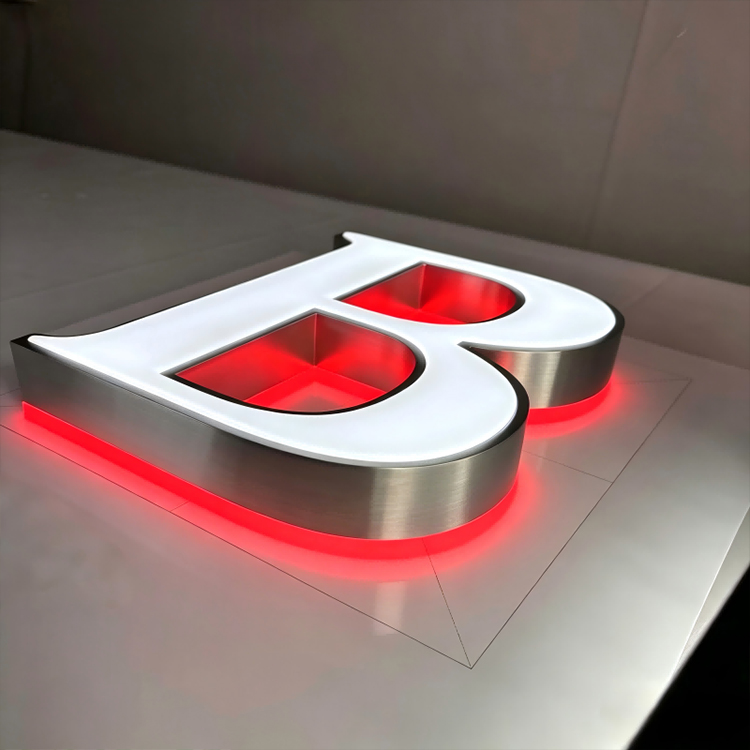
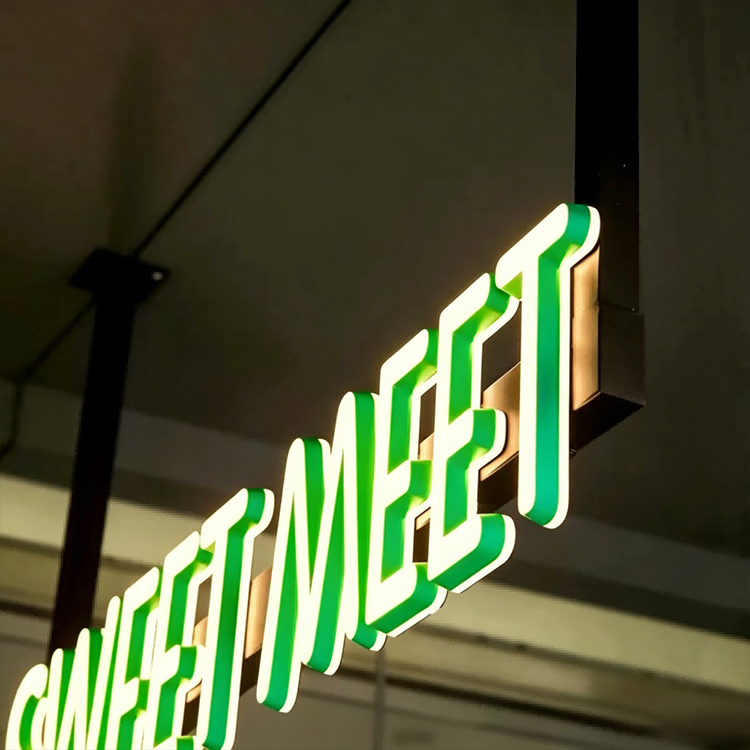
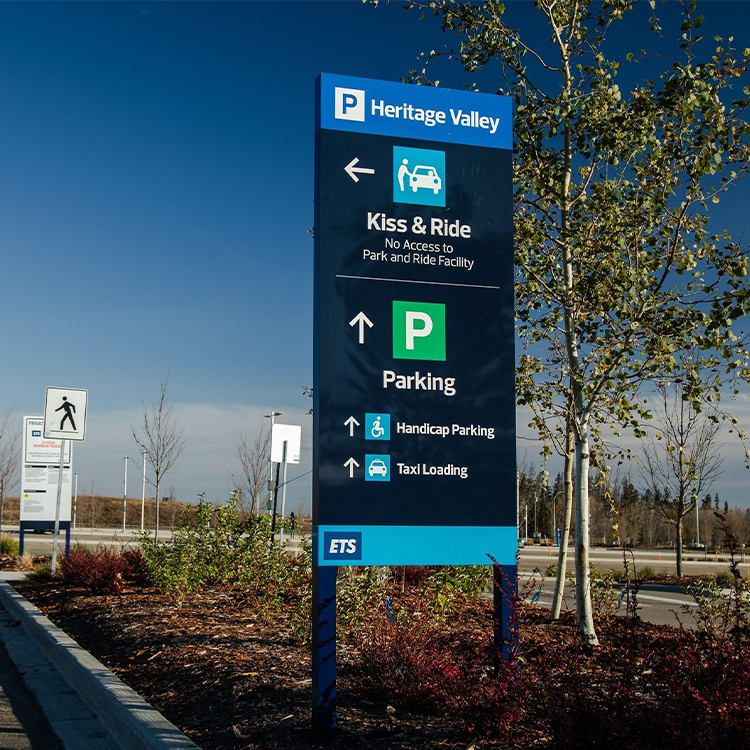
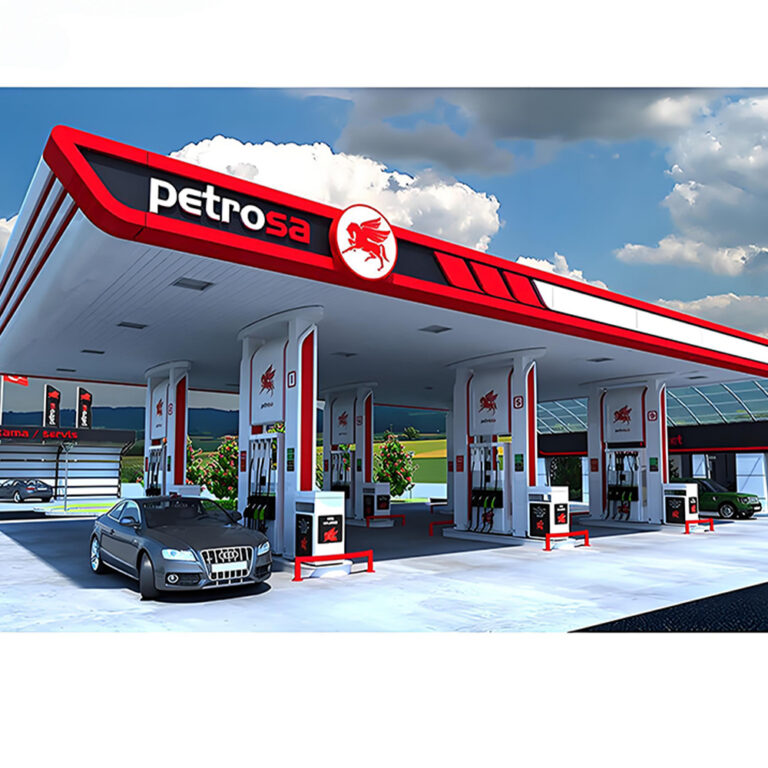
Tell us your sign type, dimensions, quantity, materials, illumination, voltage, mounting method, and delivery country. Our engineering team will review your requirements and prepare a factory quotation with recommended specifications and estimated production lead time.
Before You Leave, Get a Factory Quote
Share your drawings, dimensions, materials, quantities, illumination requirements, and delivery destination. Our signage engineering team will review your project and provide a tailored manufacturing proposal for LED letters, light boxes, pylon signs, gas station signage, or other custom sign systems.
Halo-Lit Letters for Luxury Retail and Hospitality
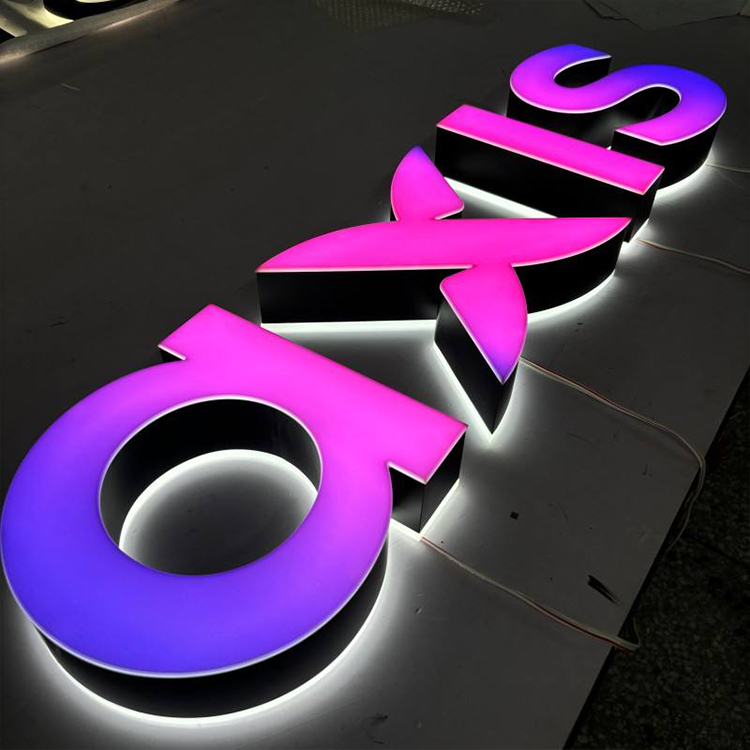
Halo-lit channel letters are dimensional metal or opaque-faced letters with concealed rear LEDs that project light onto the mounting wall. The reflected light creates a soft outline around each character, giving luxury stores, hotels, restaurants, spas, and reception spaces a more architectural nighttime identity than conventional face-lit signage.
Luxury hates glare.
A high-end façade may use imported stone, custom millwork, brushed metal, hand-finished plaster, and carefully controlled architectural lighting, yet one overpowered sign with visible LED dots can make the entire entrance feel like an ordinary shopping-center tenant.
Why spend heavily on the interior and then treat the sign as an illuminated afterthought?
I have a blunt view of this category: halo-lit letters are not automatically luxurious. They only look expensive when the fabrication, reflected light, wall finish, viewing conditions, and installation tolerances have been resolved together.
The sign is not working alone. The building is part of the optical system.
Why Luxury Brands Are Investing in Physical Experience Again
Luxury retail is under pressure, but physical environments are not becoming less important. They are being asked to do more.
Bain reported in June 2026 that worldwide luxury spending reached €1.443 trillion in 2025. Personal luxury goods declined from €364 billion in 2024 to €358 billion in 2025, yet Bain projected a 2%–4% recovery to €365–€373 billion in 2026. More revealingly, consumer interest in luxury experiences was growing about 1.5 times faster than interest in tangible goods during 2026.
The message is uncomfortable but useful: a logo above a door is no longer enough. The arrival sequence, storefront, lobby, product presentation, restaurant, bar, spa, lighting, sound, materials, and service all contribute to the perceived value of the brand.
Reuters documented the same shift in January 2026. Department stores were investing in architectural tours, dining, wine tastings, exclusive launches, and immersive environments as global department-store sales were projected to have fallen 4%–6% in 2025. Galeries Lafayette reportedly spent more than €100 million restoring its Paris cupola, while LVMH invested about €750 million in La Samaritaine—proof that costly physical upgrades do not guarantee commercial success.
That last example matters.
Expensive is not effective.
Halo-lit letters should support the experience by creating controlled depth, material quality, and nighttime recognition. They should not become the loudest object in the room.
How Halo-Lit Channel Letters Actually Work
Halo-lit channel letters are also called:
Reverse-lit channel letters
Reverse channel letters
Backlit channel letters
Rear-illuminated letters
Halo letters
Architectural LED letters
The basic construction normally includes a solid face, dimensional metal returns, an open or translucent rear, internal LED modules, stand-off spacers, concealed wiring, and a power supply.
Instead of sending light through the front, the LEDs project backward. The wall reflects that light around the perimeter of each letter.
The result depends on six interacting elements:
LED output and beam pattern
Distance between the letter and wall
Letter depth and stroke width
Wall color and reflectance
Wall texture and joint pattern
Ambient lighting around the installation
The site’s collection of custom LED backlit and halo-lit letters includes metal, acrylic, gold-finish, stainless-steel, indoor, and outdoor configurations for retail, hospitality, reception, and commercial façade projects.
One stainless-steel halo-lit letter configuration uses a 2 mm metal face with a 20 mm clear acrylic rear panel and supports cold white, warm white, or RGB illumination. That is one available construction—not a universal specification for every project—but it demonstrates why the rear diffuser and metal structure need to be defined in the approved drawing.
Halo-Lit vs Front-Lit vs Dual-Lit Letters
Decision Factor
Halo-Lit Letters
Front-Lit Letters
Dual-Lit Letters
Light direction
Reflected onto the wall
Directly through the face
Through the face and behind
Daytime appearance
Solid metal or opaque face
Acrylic or resin face
Illuminated face with dimensional body
Nighttime character
Soft, restrained, architectural
Bright, direct, highly visible
Strong visibility with added depth
Best viewing condition
Pedestrian or moderate distance
Long distance and competitive streets
Flagship façades with mixed viewing distances
Dependence on wall finish
Very high
Relatively low
Moderate to high
Typical applications
Hotels, luxury boutiques, spas, fine dining
Roadside retail, malls, dealerships, restaurants
Flagships, entertainment venues, premium restaurants
Installation sensitivity
High
Moderate
High
Wiring complexity
Moderate
Moderate
Highest
Common failure
Uneven or weak halo
Hot spots through the face
Excess light and unnecessary complexity
The full front-lit versus backlit channel letter comparison explains why front illumination usually wins on busy roads, while halo lighting performs better where architecture and material appearance carry more weight.
And sometimes neither system is enough. A brand that needs a refined rear glow but must also remain visible across a large plaza may need front-lit and backlit dual illumination.
But more light is not always better. It means more LEDs, more wiring, more heat, more power loading, more installation work, and more components that may eventually require service.
The Specification Decisions That Create a Premium Halo
A rendering can show the mood. It cannot prove the result.
I would not approve custom halo-lit letters for a flagship store or hotel façade until the following variables have been documented.
Choose the LED Color Temperature Around the Architecture
For most luxury applications, white light should be selected by Kelvin value rather than vague descriptions such as “warm,” “natural,” or “cool.”
Color Temperature
Typical Visual Effect
Suitable Applications
Main Risk
2200K–2700K
Amber, intimate, decorative
Heritage hotels, lounges, warm bronze interiors
Can distort white brand colors
2700K–3000K
Warm white, refined, welcoming
Luxury hotels, fine dining, spas, gold finishes
May appear yellow beside cool façade lighting
3500K
Balanced warm-neutral white
Contemporary hospitality and beauty retail
Requires careful matching with interior lighting
4000K
Clean neutral white
Fashion, silver metal, modern stone façades
Can feel corporate in intimate spaces
5000K–6500K
Blue-white, highly clinical
Limited brand-specific applications
Frequently looks harsh or inexpensive
For a hotel lobby with walnut, bronze, cream stone, and 2700K architectural lighting, I would usually begin with a 2700K or 3000K halo sample.
For a fashion boutique using silver stainless steel, pale limestone, and cooler track lighting, 3500K or 4000K may be more coherent.
The hard rule is simple: match the sign to the space. Do not choose 6000K because a supplier says it looks brighter in a factory video.
Treat Stand-Off Distance as an Optical Setting
The stand-off distance controls how far the halo spreads before reaching the wall.
A narrow gap tends to create a tighter, brighter outline. A wider gap can create a broader glow, but it may also reduce intensity, reveal shadows, or allow neighboring halos to merge.
These ranges can be used as mock-up starting points, not universal standards:
20–40 mm: small interior lettering and tightly controlled logos
40–75 mm: medium reception signs, boutique walls, and many exterior letters
75–120 mm: large exterior letters where a wider halo is required
The correct distance depends on LED optics, letter height, stroke width, wall material, ambient light, and the desired visual effect. A 40 mm stand-off that works behind a 400 mm letter may fail behind a narrow 100 mm script character.
Test the smallest letter.
Large characters are usually easy. Thin strokes, punctuation, registered marks, and tight counters expose the weaknesses in the design.
Use the Wall as Part of the Prototype
A smooth, matte, light-colored wall generally reflects the cleanest halo.
More difficult surfaces include:
Polished black marble
Dark granite
Mirror stainless steel
Highly veined stone
Corrugated metal
Deep brick joints
Ribbed timber
Uneven plaster
Glass curtain walls
Perforated metal panels
Dark materials absorb light. Polished materials create reflections. Deep joints interrupt the illuminated perimeter.
Adding stronger LEDs does not automatically solve these problems. It may create glare, visible module patterns, sharper reflections, greater heat, and an ugly bright patch behind each letter.
A physical sample on the actual wall material is worth more than five photorealistic renderings.
Specify the Metal Finish by Sample, Not Adjectives
“Gold,” “brushed silver,” and “champagne” are not controlled specifications.
They are opinions.
A serious approval package should identify:
Base metal
Metal thickness
Brushed, mirror, bead-blasted, painted, plated, or coated finish
Approved physical sample
Color reference where applicable
Grain direction
Edge and return finish
Indoor or outdoor use
Cleaning restrictions
Acceptable color variation between production batches
Brushed finishes are often more forgiving than mirror finishes because they show fewer fingerprints, wall reflections, adhesive marks, and minor surface distortions.
Mirror metal can look spectacular in a rendering. Under lobby spotlights, it can also reflect exit signs, ceiling vents, guests, cables, and anything else within sight.
Luxury does not mean shiny.
Best Halo-Lit Letters for Luxury Retail
Halo-lit letters work particularly well in luxury retail where customers approach slowly and the architecture has enough visual space around the brand.
Strong applications include:
Flagship storefronts
Jewelry boutiques
Watch retailers
Designer fashion stores
Beauty and fragrance boutiques
VIP consultation rooms
Private shopping salons
Cash-wrap feature walls
Mall entrance portals
Window-display back walls
Exterior Storefronts Need a Visibility Reality Check
A halo-lit logo can look beautiful from 10 metres away and disappear from 60 metres away.
That does not mean the sign is defective. It means reflected illumination was selected for a viewing condition that required direct illumination.
Before approving exterior luxury retail signage, document:
Primary viewing distance
Pedestrian or vehicle approach
Vehicle speed
Sign mounting height
Nearby digital screens
Window brightness
Streetlights
Neighboring illuminated signs
Daytime wall contrast
Nighttime ambient light
For a pedestrian luxury street, halo-lit metal letters may be ideal.
For a retailer facing a six-lane road, large parking area, or brightly illuminated shopping complex, I would strongly consider front-lit or dual-lit letters.
Subtlety has limits.
Interior Retail Signs Can Use Lower Output More Effectively
Inside a boutique, lower-output halo lighting often looks better because the surrounding light is controlled.
The goal is not to flood the wall. It is to separate the letter from the background and reveal dimensional depth.
A jewelry store may benefit from a warm-white halo behind brushed champagne or gold-tone letters. A contemporary fashion brand may prefer neutral-white light behind satin black, silver, or painted letters.
RGB lighting should be treated carefully. Constant color-changing effects can make a luxury identity feel temporary or promotional unless motion and color are already part of the brand system.
And the sign should not be expected to illuminate merchandise. Product lighting and identity lighting solve different problems.
Halo-Lit Letters for Hotels and Hospitality Spaces
Hospitality signage has to perform across several emotional and functional stages:
Identify the property from the street
Confirm the arrival point
Guide vehicles and pedestrians
Establish the lobby atmosphere
Identify restaurants, bars, spas, and event spaces
Direct guests to lifts, rooms, and amenities
One sign type cannot handle all six jobs.
Halo-lit letters are strongest as identity elements. They work well for:
Hotel façade names
Porte-cochère branding
Lobby logo walls
Reception backdrops
Restaurant names
Rooftop bars
Spa entrances
Ballroom identities
Branded event spaces
They are not automatically the right format for parking guidance, room numbers, emergency information, accessible routes, or complex directional systems.
Brand Identification and Wayfinding Must Be Separated
Here is a hard truth for hospitality designers: a beautiful hotel logo does not fix a confusing arrival.
Guests need to understand where to turn before they reach the driveway, where to stop before they pass the entrance, and where to park before they block a service lane.
Façade letters, entrance signs, monument signs, pylons, directional arrows, parking signs, and internal wayfinding should be designed as one information hierarchy, even when different sign types are used.
A refined halo-lit hotel name may anchor the visual identity. The directional system must still be faster to read than it is beautiful.
Decorative Letters Do Not Replace Accessible Signage
In the United States, hospitality buyers also need to separate decorative brand signage from signs regulated under the Americans with Disabilities Act.
A 2017 U.S. Department of Justice settlement involving the Wyndham Southbury Hotel required signage throughout the property to meet Section 703 requirements and specifically addressed noncompliant restroom, fitness-center, locker-room, and accessibility signs.
The lesson is not that every halo-lit logo needs Braille. Company names and logos can be treated differently from permanent-room, directional, restroom, exit, and accessibility signs.
The lesson is that a hospitality sign package must identify which signs are decorative and which signs perform regulated communication functions.
Do not leave that classification until installation week.
LED Efficiency Is Real, but Cheap Components Still Fail
The shift from neon tubes and conventional lamps to LEDs has reduced the energy demand of many illuminated sign systems.
The U.S. Department of Energy reported that LED lighting produced 1.1 quads of energy savings in 2017, equal to about $12 billion in savings for U.S. consumers. DOE projected that LED energy savings could reach 569 terawatt-hours annually by 2035 if program research goals were achieved.
But a broad LED energy statistic does not prove that a particular halo-lit sign is efficient, reliable, or properly engineered.
An LED system can fail because of:
Water entering the letters
Overloaded power supplies
Poor heat dissipation
Corroded connectors
Inconsistent LED color bins
Weak cable joints
Incorrect voltage
Inaccessible power supplies
Adhesive failure
Damaged wall penetrations
Poorly designed drainage
Excessive dimming flicker
I would ask for the exact LED module and power-supply specification, not “high-quality LED” or “famous-brand transformer.”
For suitable projects, the manufacturer states that illuminated signs can be configured with IP68 LED modules rated at 110 lm/W and IP65 Mean Well power supplies. Those components should appear in the quotation and approved bill of materials if they are required; a website statement alone is not a purchasing specification.
Practical Electrical Questions Buyers Should Ask
Ask the supplier:
Is the system 12V DC or 24V DC?
What is the LED module brand and model?
What is the stated color temperature?
Is the LED color bin controlled for repeat orders?
What is the module IP rating?
What is the power-supply brand and model?
What percentage of the power supply’s rated capacity will be used?
Where will the power supplies be installed?
Can each power supply be reached without removing the finished wall?
Is dimming required?
Is the dimmer compatible with the selected power supply?
How will cables pass through the wall?
How are exterior penetrations sealed?
What electrical listing or certification is required in the installation country?
Designing a power supply at 100% of its nameplate load leaves little margin for temperature, voltage variation, and future degradation. Many experienced fabricators work around an 80% loading target, but the final requirement should be documented by the electrical designer and component manufacturer.
The Procurement Process I Would Insist On
Luxury projects often suffer from an unusual problem: too many people approve the appearance, while nobody owns the manufacturing details.
The architect approves the concept. The branding agency approves the logo. The interior designer approves the finish. The electrical contractor assumes the sign company handles the wiring. The sign company assumes the wall is ready. The installer discovers a steel beam behind the letter pattern.
Then everyone blames production.
For a custom project, I would require the following sequence.
1. Site Information Before Quotation
Provide:
Project address and country
Interior or exterior use
Wall elevation
Installation photographs
Wall material and color
Sign mounting height
Primary viewing distance
Nearby lighting conditions
Available input voltage
Power-supply access point
Installation restrictions
2. Controlled Artwork
Provide editable AI, EPS, SVG, DWG, DXF, or vector PDF files.
Confirm:
Overall sign width
Letter heights
Stroke widths
Spacing
Logo proportions
Registered marks
Minimum manufacturable details
3. Full-Size Prototype
The prototype should reproduce:
Actual metal finish
Actual LED model
Actual LED color temperature
Actual letter depth
Actual rear diffuser
Proposed stand-off distance
Real wall material or an accurate sample
Realistic ambient lighting
Photograph the sample with controlled camera exposure. A dark-room phone photograph can exaggerate the halo and mislead decision-makers.
4. Approved Production Documents
The final approval set should include:
Dimensioned shop drawings
Cross-section
Metal specification
Finish reference
LED layout
Power-supply schedule
Wiring diagram
Mounting pattern
Stand-off dimensions
Cable-entry positions
Drainage details
Installation template
Packing method
Compliance responsibilities
The manufacturer’s OEM and ODM signage service is structured around drawing review, material selection, prototype development, LED integration, inspection, export packing, and controlled repeat production.
5. Inspection Before Shipping
Inspection should verify:
Overall dimensions
Letter depth
Metal finish
Grain direction
Edge quality
Weld quality
Halo uniformity
LED color consistency
Wiring polarity
Power-supply operation
Mounting-hole positions
Template accuracy
Accessories
Labels
Packaging protection
Define the burn-in requirement in the purchase order. “All signs tested” is too vague. Specify whether the electrical test must run for 8 hours, 24 hours, or another agreed period.
For multi-location projects, retain an approved finish sample, LED specification, drawing revision, mounting template, and bill of materials. Otherwise, the tenth store may not match the first.
Common Mistakes That Make Halo-Lit Letters Look Cheap
The Halo Is Too Bright
The sign becomes a glowing wall stain rather than a controlled outline.
Reduce output, adjust the stand-off, change the diffuser, or use dimming. Do not assume more brightness means stronger luxury positioning.
The Wall Is Too Dark
The buyer approved a photograph taken in total darkness. Under normal façade lighting, the halo nearly disappears.
Test the real wall under real operating conditions.
The LED Color Does Not Match the Interior
A 6000K blue-white sign sits inside a 2700K hotel lobby.
Nothing else needs to go wrong. The mismatch is already obvious.
Individual Letters Are Mounted at Different Distances
A few millimetres of variation can change the halo width, particularly with small letters.
Use rigid spacers, a full-size mounting template, and controlled fixing points.
Power Supplies Are Buried Behind Finished Walls
The sign works at handover. A driver fails later. Replacing it requires damaging stone, timber, or plaster.
Luxury signage without service access is future demolition work.
A Script Logo Is Fabricated Without a Full-Size Test
The logo may be mathematically accurate and visually wrong.
FAQs
What are halo-lit channel letters?
Halo-lit channel letters are three-dimensional letters or logos with opaque faces and concealed rear LEDs that project light onto the mounting surface, producing a soft illuminated outline around each character while preserving a solid metal or painted daytime appearance in daylight.
They are also commonly called reverse-lit, backlit, or reverse channel letters. Their final appearance depends on the wall almost as much as the fabricated letter itself.
Are halo-lit letters best for luxury retail?
Halo-lit letters are a strong choice for luxury retail when the storefront or interior wall has enough contrast, the viewing distance is moderate, and the brand values architectural restraint more than maximum brightness, because the reflected glow creates depth without the bright acrylic face associated with conventional commercial signage.
They are less suitable when customers must identify the store from fast-moving traffic, across a large car park, or among powerful competing signs. In those cases, front-lit or dual-lit letters may communicate more effectively.
What color temperature is best for hotel halo-lit letters?
A 2700K to 3000K warm-white halo is usually the safest choice for luxury hotels, fine dining, spas, and gold or bronze finishes, while 3500K to 4000K can suit cooler stone, silver metal, contemporary fashion interiors, and properties that need a cleaner, more neutral nighttime appearance.
The sign’s color temperature should be tested beside the property’s façade, lobby, or feature-wall lighting. Avoid approving the LED color from an isolated factory video.
How far should halo-lit letters stand off the wall?
Most halo-lit letters require a controlled stand-off gap between the rear of the letter and the wall, but the correct distance must be established through a full-size sample because letter size, LED beam pattern, wall color, surface texture, ambient light, and desired halo width all change the result.
Small interior signs may begin testing around 20–40 mm, while medium and large letters may require 40–120 mm. These ranges are prototype starting points rather than fixed engineering rules.
Can halo-lit channel letters be installed outdoors?
Halo-lit channel letters can be used outdoors when the metal body, rear diffuser, LED modules, wiring, connectors, power supplies, drainage, wall penetrations, fasteners, and sealants are specified for the exposure conditions and the mounting surface remains suitable for reflecting a consistent halo after rain, dust, heat, and ultraviolet exposure.
The project team should also review wind loads, coastal corrosion, service access, electrical approval, building permits, landlord criteria, and local sign ordinances before manufacturing begins.
Are halo-lit letters ADA compliant?
Halo-lit brand names and logos are not substitutes for ADA-compliant room-identification, directional, restroom, exit, or accessibility signs, because decorative corporate identity signage serves a different function from regulated visual and tactile communication that may require specific contrast, character forms, mounting heights, raised text, pictograms, and Braille.
A hotel may use halo-lit letters for its façade name, lobby identity, restaurant, or spa brand while maintaining a separate compliant system for rooms, facilities, exits, and guest directions.
How much do custom halo-lit letters cost?
Custom halo-lit letter pricing depends on overall size, letter height, stroke width, metal grade, finish, LED color, power system, mounting method, certification, quantity, packaging, and shipping, so a credible quotation requires drawings and site information rather than a generic price per letter.
Mirror stainless steel, complex script logos, very small strokes, exterior certification, difficult mounting, and low-volume custom finishes usually add cost. Repeat orders may become more economical once drawings, templates, samples, and component specifications are controlled.
Turn the Rendering Into a Buildable Sign
Halo-lit channel letters can give luxury retail stores and hospitality properties a restrained, architectural identity that works during the day and after dark.
But the halo is not a decorative filter added at the end of the design.
It is the result of metal construction, LED optics, color temperature, stand-off distance, wall reflectance, ambient light, wiring, mounting accuracy, and service planning.
Send your vector logo, dimensions, quantity, wall elevation, wall material, finish reference, preferred LED color, operating voltage, installation country, and target delivery schedule through the custom signage project inquiry page.
Ask for a project-specific construction recommendation, dimensioned drawing, component schedule, finish sample, and full-size illumination mock-up before releasing the order.
That is how a luxury sign stays luxurious after installation.
Custom Signage Factory manufactures commercial signs for sign companies, contractors, distributors, and multi-site brands. With a 20,000 m² workshop, 80+ production workers, 50+ machines, and an annual capacity of 100,000 pieces, we produce LED letters, light boxes, pylon signs, gas station signage, neon signs, and custom OEM sign systems.